
The Island Premise
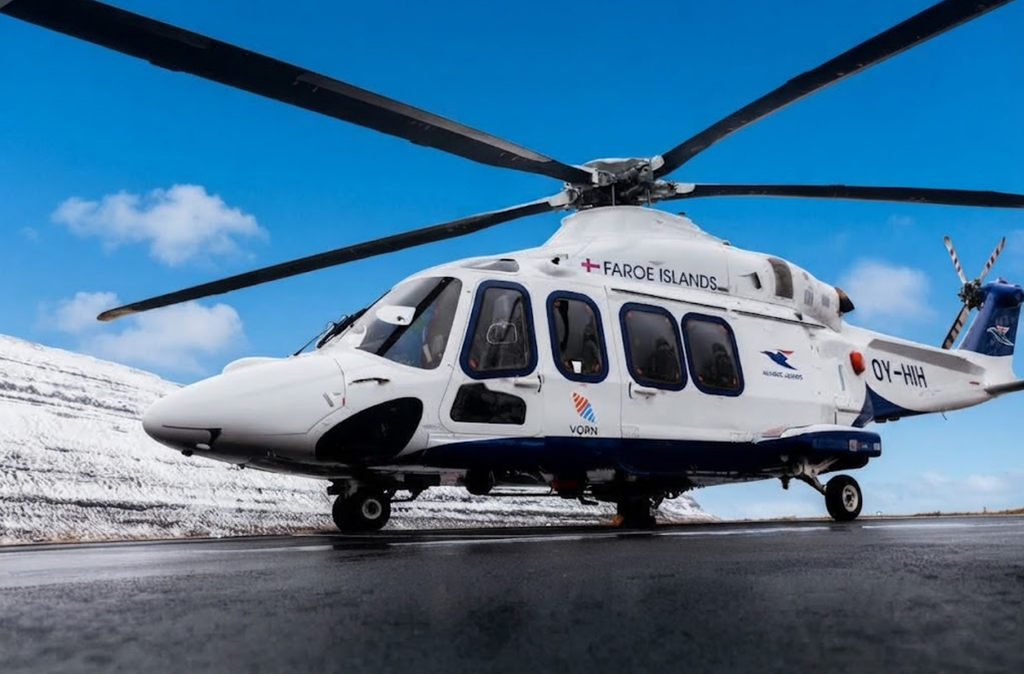
Every arrival in the Faroe Islands begins with a negotiation with the sea. Vágar Airport, the archipelago’s only international gateway, sits on the western edge of the islands, a runway carved between mountains and fjords. To reach Tórshavn, the capital, you must cross water and tunnel. Most travellers take the bus or rent a car, winding through the Vágatunnilin sub‑sea passage. But there is another way — faster, rarer, and more dramatic. The helicopter transfer is not just transport; it is theatre. Twelve minutes in the air, blades cutting through Atlantic wind, and you step into the city centre with a story already written.
The Practical Frame
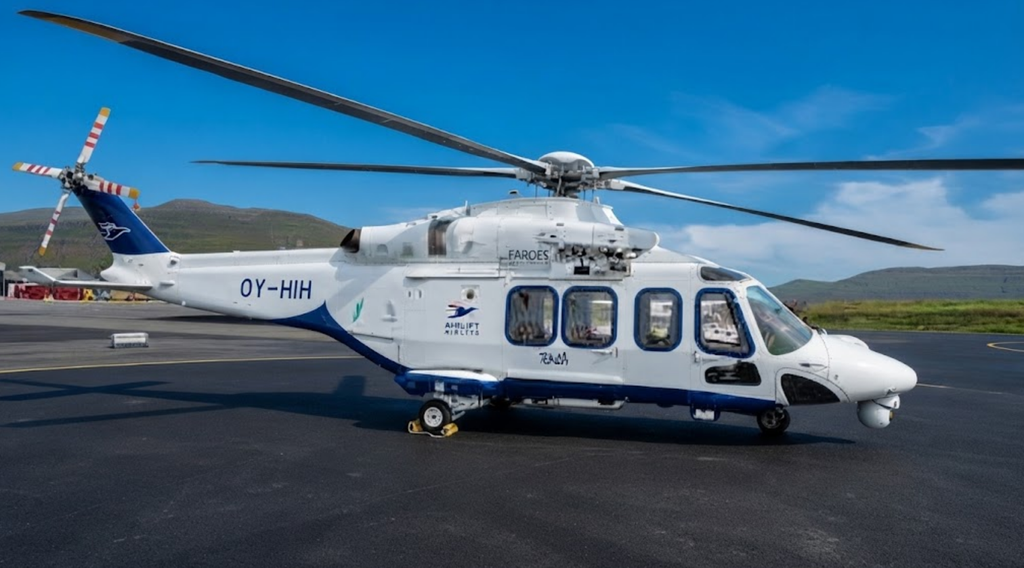
The helicopter service is operated by Atlantic Airways, the national carrier. Flights run several times a week, though not daily, and schedules shift with demand and weather. The journey takes about twelve minutes, covering the 45 kilometres between Vágar and Bodanes Heliport, just outside Tórshavn. Fares hover around DKK 750–1,000 (USD 110–150). It is not the cheapest way to travel, but it is the swiftest, and for many, the most memorable.
The Departure
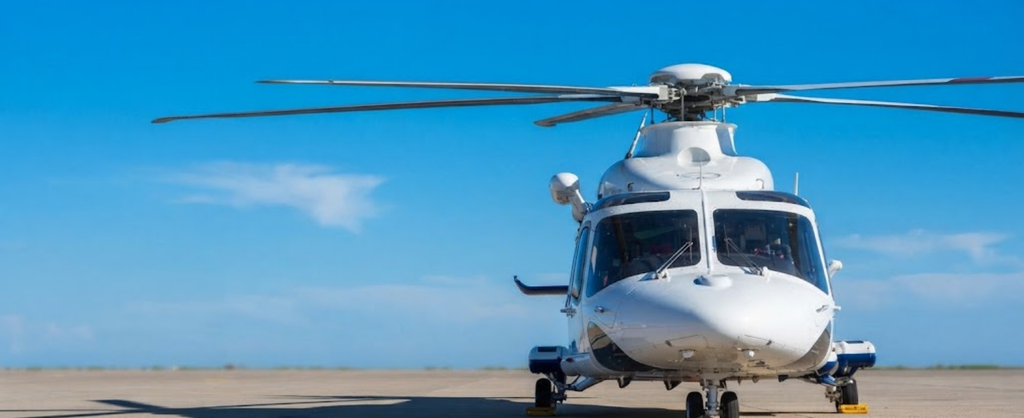
At Vágar, the helicopter terminal is modest, tucked beside the main airport building. Check‑in is brisk; there are no long queues, no duty‑free distractions. Security is light compared to international flights. You wait in a small lounge, often with locals heading to remote villages, sometimes with tourists chasing novelty. When the rotors start, the sound fills the valley. Boarding is quick — seven to twelve passengers, depending on the aircraft. Seat belts click, ear protection is handed out, and the cabin vibes with anticipation.
The Flight Experience
The helicopter rises almost vertically, clearing the runway and climbing into the sky. Within seconds, the Atlantic spreads beneath you, a quilt of fjords, cliffs, and scattered villages. The pilot banks east, tracing the line of the islands. On clear days, you see the jagged silhouettes of Streymoy and Eysturoy, the ridges of Vágar fading behind. On foggy ones, the world shrinks to a tunnel of cloud, blades slicing through mist. Unlike fixed‑wing aircraft, helicopters fly low, close enough to see sheep grazing on slopes, waterfalls spilling into valleys, fishing boats cutting across the strait.
The Arrival Scene
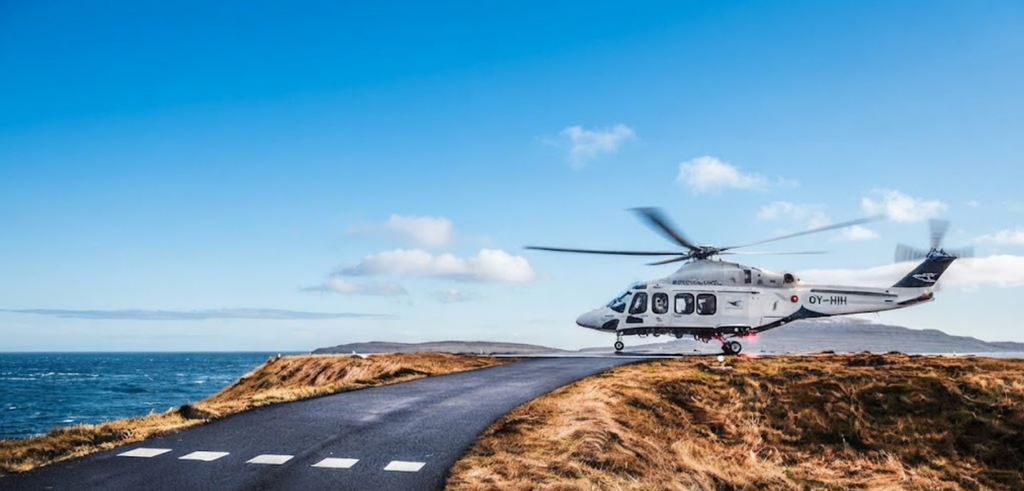
Bodanes Heliport sits on the edge of Tórshavn, a short taxi ride or 20‑minute walk from the city centre. The landing is smooth, the cabin doors open, and you step into the capital almost instantly. No tunnels, no traffic, no ferry queues. For business travellers, this speed is priceless. For visitors, it is a spectacle — a way to arrive in Tórshavn with the islands already revealed from above.

The Weather Factor
The Faroe Islands are notorious for sudden weather shifts. Fog rolls in without warning, winds rise, rain lashes sideways. Helicopters, unlike floatplanes, operate under Instrument Flight Rules, meaning they can fly in low visibility. But extreme winds or icing conditions can still ground them. Winter flights are generally reliable; summer fog can be trickier. Travellers should book refundable fares and keep backup plans. The helicopter is fast, but it is not invincible.
The Economics of Choice
Compared to the bus (DKK 30, USD 4) or taxi (USD 100–120), the helicopter is expensive. But cost is not the only metric. Time matters. The bus takes nearly an hour, the taxi forty minutes. The helicopter takes twelve. For executives with morning meetings, for travellers connecting to onward ferries, for those who value experience over savings, the premium is justified. It is not mass transport; it is a niche service, designed for those who measure journeys in minutes, not kroner.
The Cultural Layer
Helicopters in the Faroe Islands are not just tourist novelties. They are lifelines. Atlantic Airways operates routes to remote villages and islands where ferries are infrequent or seas too rough. Locals use them for medical transfers, urgent travel, or simply to connect communities. The Vágar–Tórshavn leg is part of this network, a bridge between the airport and the capital. To ride it is to step into the rhythm of island life, where helicopters are as ordinary as buses, yet as extraordinary as theatre.
The Scenic Argument
From the air, the Faroe Islands reveal themselves differently. Roads show you valleys; ferries show you coastlines. Helicopters show you the whole. You see the geometry of fjords, the layering of cliffs, the scatter of turf‑roofed houses. You see how villages cling to slopes, how tunnels pierce mountains, how the ocean frames everything. For photographers, the flight is a gift. For writers, it is metaphor. For travellers, it is memory.
The Logistics of Booking
Tickets can be booked through Atlantic Airways’ website or at the airport. Seats are limited, and flights often fill quickly. Advance booking is recommended, especially in summer. Refundable fares are wise, given weather risks. Check‑in closes 30 minutes before departure. Luggage allowances are smaller than on fixed‑wing flights; pack light. The helicopter is not designed for heavy cargo, but for swift human transfer.
The Comfort Equation
Cabins are tight, seats narrow, headroom limited. The noise is constant, even with ear protection. The ride can be bumpy in wind. It is not luxury in the conventional sense. But comfort is not the point. The point is speed, spectacle, and story. You endure the noise for the view, the tightness for the time saved. For twelve minutes, you are part of the machinery of the islands, lifted above sea and stone.
The Comparative Lens
- Bus: Cheapest, slowest, reliable.
- Taxi: Convenient, costly, flexible.
- Car rental: Freedom, but traffic and parking.
- Helicopter: Fastest, most expensive, most dramatic.
Each option has its place. The helicopter is not for everyone. But for those who choose it, it defines the journey.
The Symbolic Weight
To fly by helicopter from Vágar to Tórshavn is to compress geography. It is to leap over tunnels and traffic, to bypass the rituals of ferries and buses. It is to see the islands as a map, not a maze. It is to arrive in the capital with a sense of scale, of drama, of privilege. It is not just transport; it is statement.
The Island Lesson
The Faroe Islands teach you to respect weather, to plan for failure, to value backup plans. The helicopter embodies that lesson. It is swift, but vulnerable. It is dramatic, but practical. It is luxury, but necessity. To ride it is to understand the islands differently — not just as places to cross, but as places to rise above, briefly, before returning to earth.