
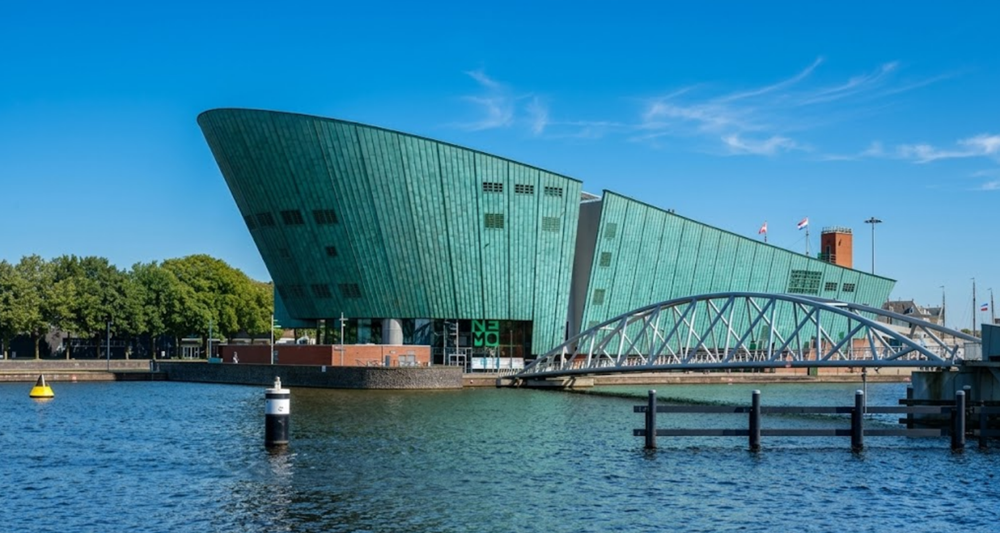
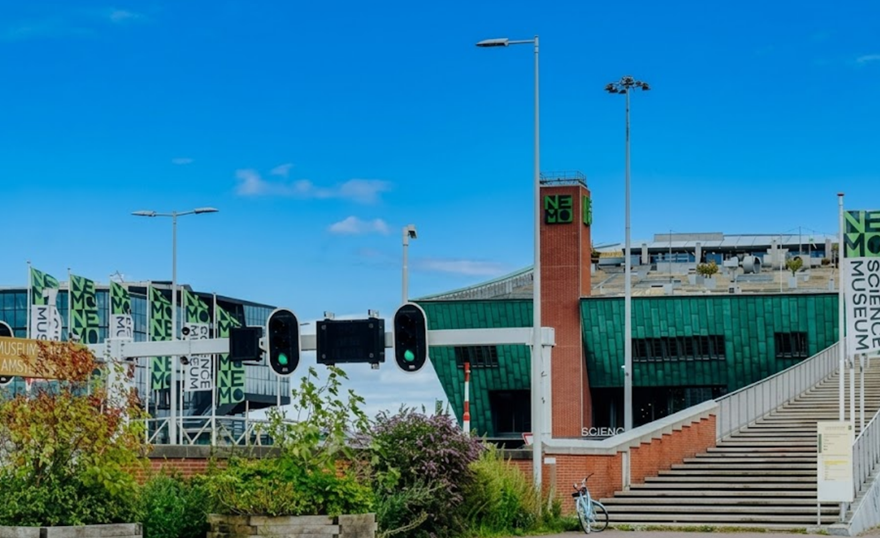
There are places in Amsterdam that feel like they belong to the past — the canals, the gabled houses, the Rijksmuseum with its Rembrandts. And then there is NEMO Science Museum, a building that belongs to the future. Rising from the Oosterdok like the prow of a ship, its copper‑green hull tilts toward the sky, a bold gesture by Italian architect Renzo Piano.
It looks as though it might set sail at any moment, carrying the city’s curiosity out into the world.Step inside, and you discover that NEMO is not a museum in the traditional sense. It is a laboratory of play, a theatre of science, a place where questions are not answered but multiplied.
With five floors of interactive exhibits, workshops, and experiments, it is the largest science centre in the Netherlands — and one of the most visited museums in the country. More than 700,000 people walk through its doors each year, each of them drawn by the promise of discovery.
The First Encounter: Soap Bubbles and Chain Reactions
The lobby sets the tone. Children rush toward the “soap bubble area,” where shimmering spheres rise into the air, some large enough to step inside. It is a simple trick of surface tension, but here it feels like magic. Nearby, a gift shop sells miniature versions of the museum’s attractions — domino sets, DNA kits, plasma balls — souvenirs of curiosity itself.
On the first floor, the theme is DNA and chain reactions. A giant domino circuit clatters into motion, setting off bells, levers, and even a flying car. Every half hour, a show begins: a chain reaction performance moderated in Dutch and English, where one movement triggers another in a cascade of cause and effect.
It is science as theatre, and the audience — children, parents, tourists — gasps and laughs as the contraptions spring to life.
Fenomena: Everyday Science Revealed
The “Fenomena” area is perhaps the most enchanting for younger children. Here, physics is stripped of abstraction and revealed in its everyday forms: the colours of a rainbow, the crackle of a sweater, the reflection of sound waves. Exhibits invite you to mix beams of light, to test how materials move differently, to conjure static electricity with your own hands.
It is a reminder that science is not distant. It is in the way your voice echoes, in the way colours blend, in the way the world surprises you when you look closely. Parents watch as their children discover that ordinary phenomena are extraordinary once you understand them.
Technium: The Ball Factory and the World of Shapes
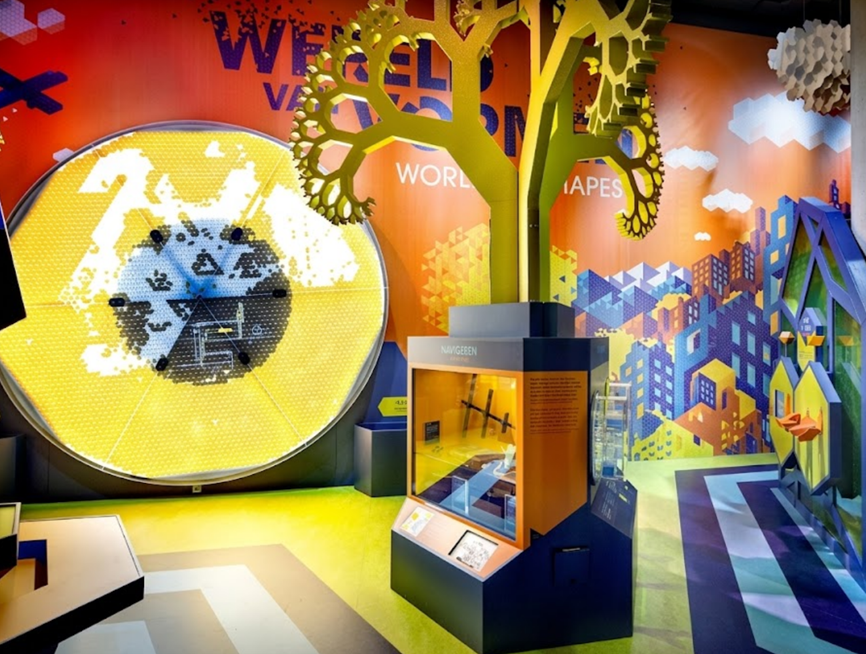
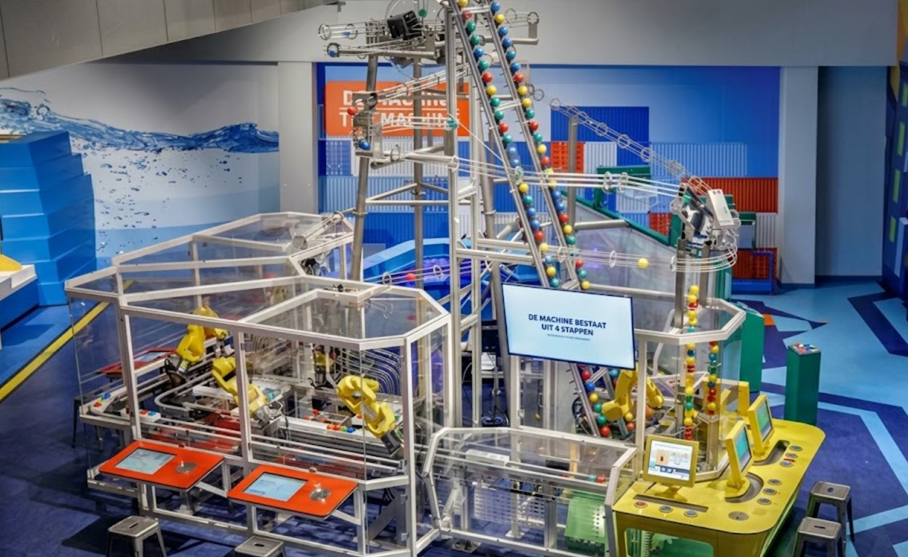
Climb to the second floor, and you enter the “Technium.” Here, a giant machine sends coloured balls through a labyrinth, demonstrating the logic of logistics. Participants group them by weight, size, and colour, attach magnetic barcodes, and send them off to be packed. It is playful, but it is also a lesson in how systems work — how order emerges from chaos.
Around the hall, other exhibits invite you to explore shapes and illusions. Chairs that dwarf you or shrink you, wheels that spin patterns into being, rooms where children become giants and adults shrink to miniature. It is a carnival of perception, a place where your senses are tricked and your assumptions overturned.
Elementa: Life in the Universe
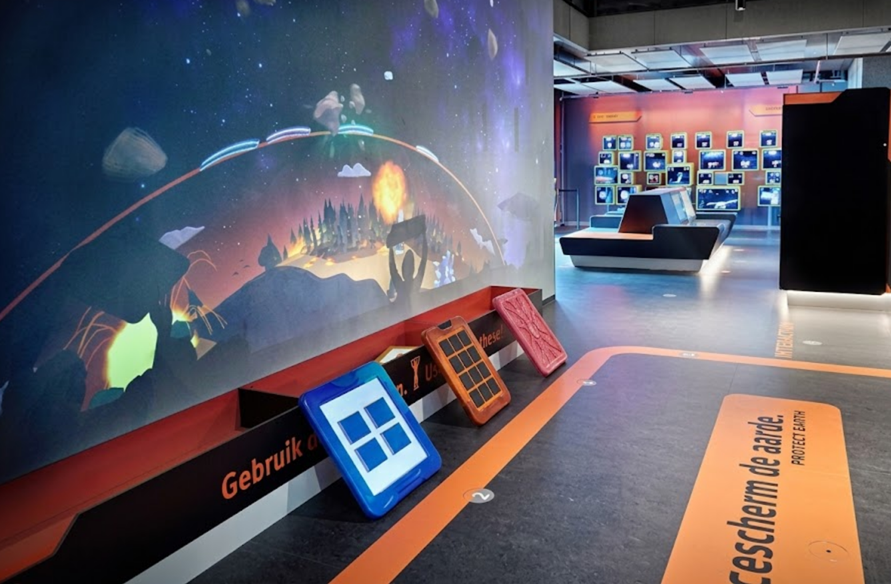
The third floor, “Elementa,” expands the scale of curiosity. A massive screen invites children to defend Earth from cosmic threats — comets, meteorites, solar winds. Holding shields above their heads, their movements are mirrored on the screen, turning science into a game of survival.
Workshops take place here too, thirty‑minute sessions where children don lab coats and become scientists. They test substances for vitamin C, examine DNA, and learn that science is not just something you watch but something you do. For families, it is a chance to see children step into the role of chemist or engineer, their faces lit with concentration.
Humania: The Journey Through the Mind
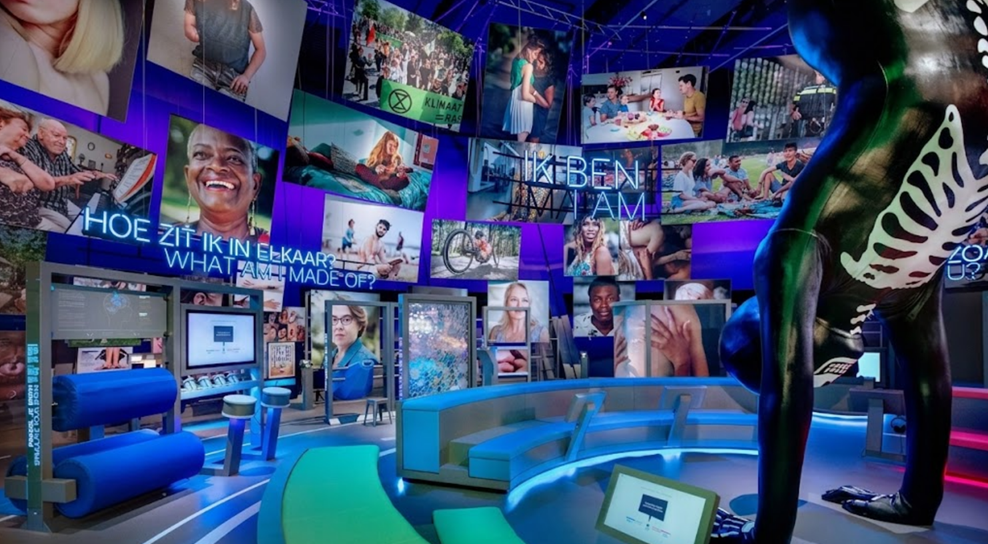
On the fourth floor, the mood shifts. The lighting is dim, the atmosphere eerie. This is “Humania,” the section devoted to the human mind and body. Exhibits test memory, challenge perception, and explore the senses. There are machines that simulate a French kiss, puzzles that reveal how easily the brain can be tricked, and experiments that probe the mysteries of thought.
For younger children, some of these exhibits are baffling or even unsettling. For older visitors, they are fascinating — a reminder that the greatest mystery is not the universe but ourselves.
The Roof: Energetica and the City Square
Finally, you reach the roof. Here, Amsterdam opens before you in a panorama of canals, bridges, and rooftops. The roof deck is the highest city square in the Netherlands, and it hosts “Energetica,” an open‑air exhibition devoted to renewable energy. Windmills spin, solar panels gleam, and interactive sculptures let you feel the forces of nature at work.
It is a fitting finale: after exploring the microcosm of DNA and the macrocosm of the universe, you stand in the open air, reminded that science is not confined to laboratories but woven into the city itself.
Accessibility and Atmosphere
NEMO is designed for everyone. Service dogs are welcome, entrances are wheelchair accessible, lifts and wide passageways make navigation easy, and restrooms are adapted for reduced mobility. Audio descriptions, open captioning, and accessible information ensure that visitors who are blind, partially sighted, deaf, or hard of hearing can participate fully.
Even hidden disabilities are acknowledged, with the Sunflower lanyard recognised here.It is a museum that understands curiosity is universal, and that science belongs to all.
Practical Notes
Lockers: Free, with video surveillance — perfect for strollers and bags.
Food: Cafeterias on multiple floors, but you can also bring your own food, useful for allergies.
Timing: Saturdays are less crowded than Sundays. Rush hour is between 12 and 2 pm. Most visitors stay 3–4 hours.
Tickets: Children under 3 enter free. From age 3+, tickets are €16.50.
Opening Hours: Tuesday–Sunday, 10:00–17:30. Last admission at 15:30.
Why NEMO Matters
In a city of art and history, NEMO is the counterpoint. It is not about preserving the past but about igniting the future. It is a place where children stand inside bubbles, where adults rediscover the thrill of asking “why,” and where families leave with the sense that the world is bigger, stranger, and more beautiful than they thought.
Science here is not abstract. It is tactile, playful, theatrical. It is the rainbow you conjure, the ball you send through a machine, the illusion that makes you laugh. NEMO insists that science is not something you learn from a book but something you live.
The Verdict
NEMO rocks. It is massive, yes, but more importantly it is alive. It triggers, teaches, and inspires all at once. It is a ship of curiosity moored in the heart of Amsterdam, a place where the future feels within reach. Spend three hours here and you will want more. Spend a day and you will leave with your mind buzzing, your senses sharpened, your imagination expanded. NEMO is not just a museum — it is an adventure.