
Appenzell > Things to do in Appenzell > Marwees Ridge Hike
Arrival in Wasserauen
Every great hike begins with a threshold, and for the Marwees Ridge trail, that threshold is Wasserauen. This small settlement in the Schwendetal Valley is more than just a trailhead; it is a hub of alpine life, where trains arrive from Appenzell and Weissbad, and hikers spill out into meadows alive with the sound of cowbells.
The valley feels enclosed, almost protective, but the moment you step through the paragliding landing field and pass the modest turnstile, the Alpstein massif begins to open ahead. The bustle of Wasserauen fades quickly, replaced by the quiet rhythm of boots on timber steps as the trail ascends into beech forest.
Into the Forest
The first ascent is steady, reinforced with timber and metal steps, carrying you into a canopy where light filters green and the air is damp with the scent of leaves. Within twenty minutes, you reach a gate marked with alpine warnings: leash your dog, keep distance from cattle.
These signs are reminders that the trail is not only a passage for hikers but also a living landscape of pastures and herds. Beyond the gate, the Bogartenlücke saddle rises into view, a dramatic notch in the ridge split by the solitary spire of Bogartenmannli. Already, the hike begins to hint at the drama to come.
Climbing Toward Bogartenlücke
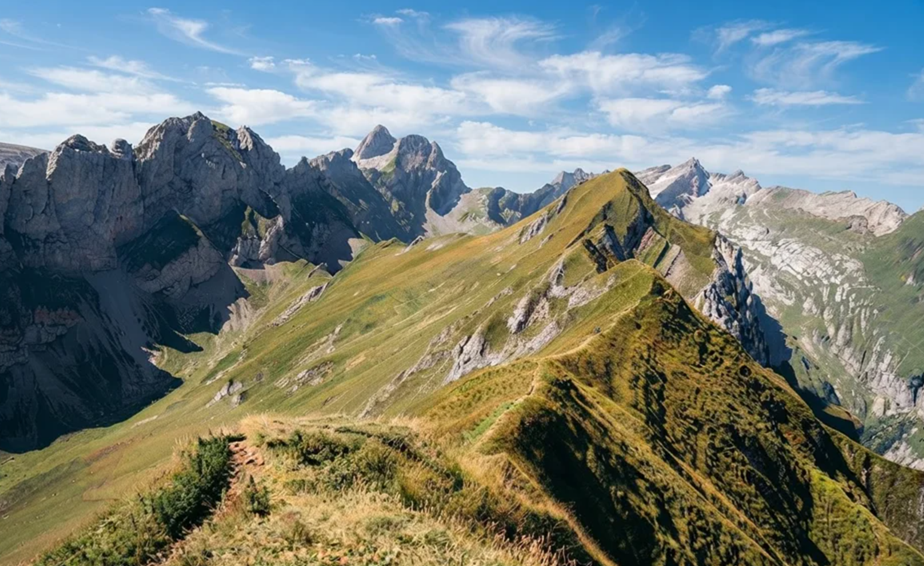
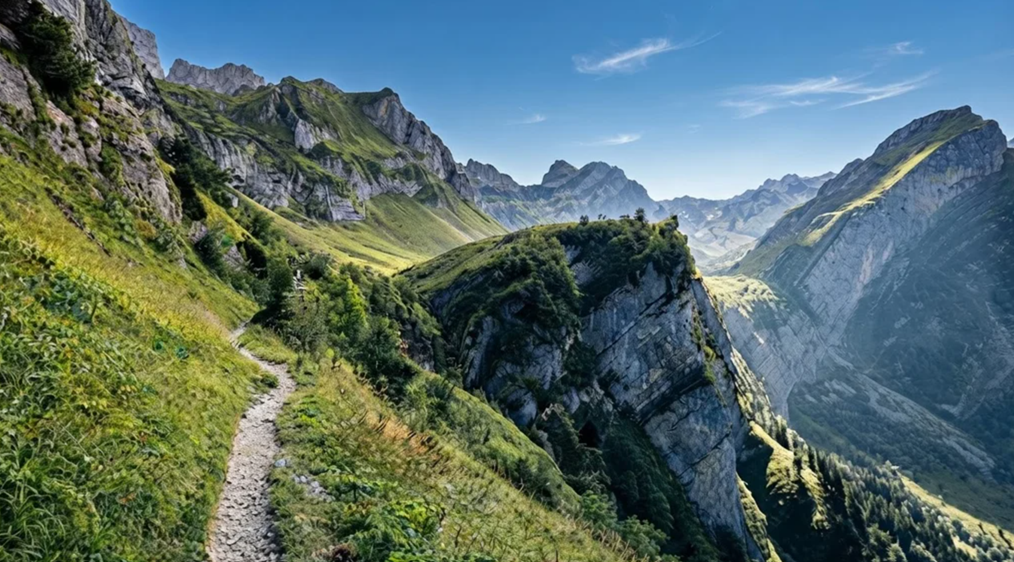
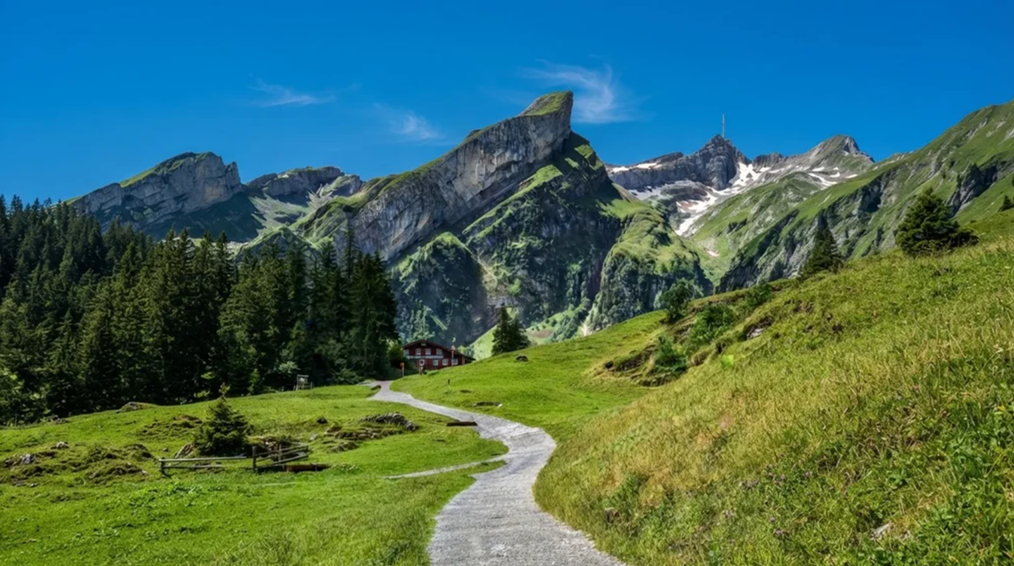
Gravel steps steer you toward Klein-Hütten, and from there the trail begins its steady climb through summer pastures. Cows graze lazily, indifferent to the effort of hikers winding upward in serpentines. The views expand with each turn: Schäfler’s jagged crest, Altenalp Türm’s rocky tower, and the distant crown of Säntis, the highest peak in the Alpstein.
The ascent sharpens as you approach Alp Mans, where boulders scatter the slope and the trail narrows into a rugged push. At the Bogartenlücke saddle, Alp Bogarten lies below, a hut nestled in green, while ahead a sign warns in four languages of the alpine route: dangerous when wet, suitable only for experienced hikers, passable at your own risk.
This is the threshold where the hike transforms from strenuous to serious.
The Dreifaltigkeit Wall
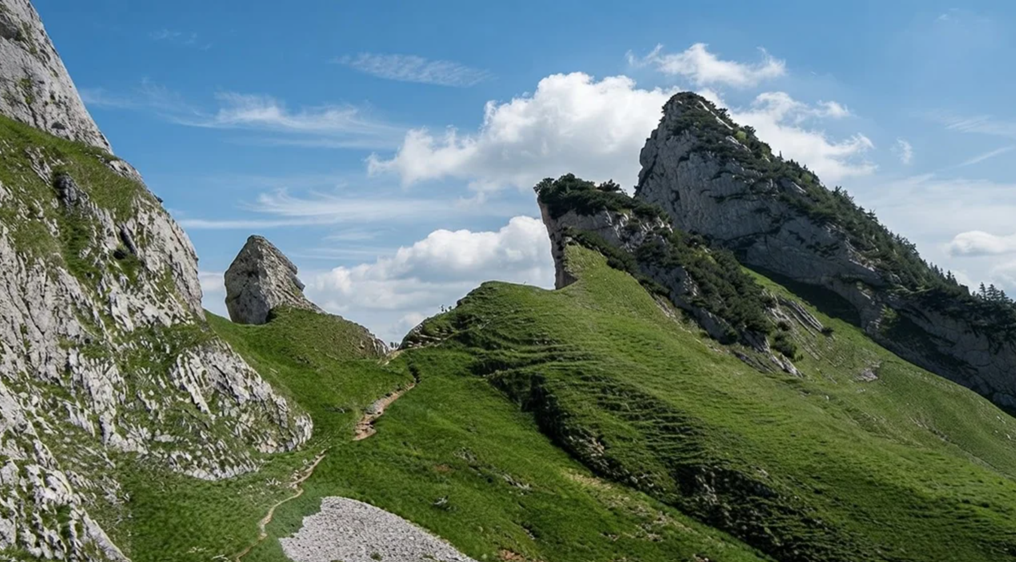
From Bogartenlücke, the trail dips briefly before twisting upward through a steep channel bordered by the Dreifaltigkeit wall, three blade-like spires rising like cathedral towers. Switchbacks claw at the slope, timber posts marked white-blue-white guiding you higher.
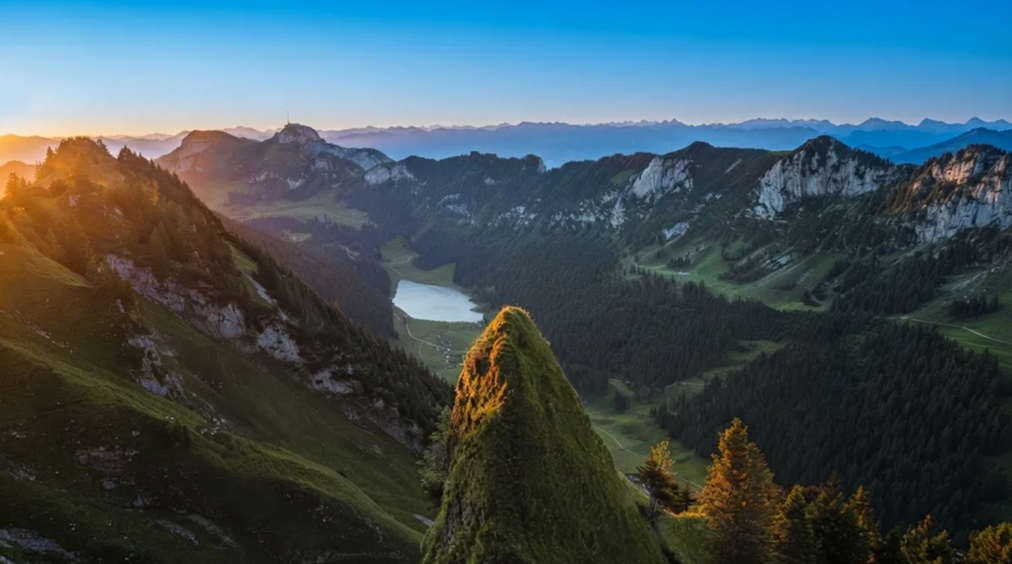
The views expand with each step: Hoher Kasten crowned with its weather station, Lake Sämtisersee shimmering in the valley, and the jagged procession of Schäfler Ridge stretching across the horizon. The climb is demanding, but the landscape rewards every effort, unfolding in layers of rock and meadow.
The Eastern Summit of Marwees
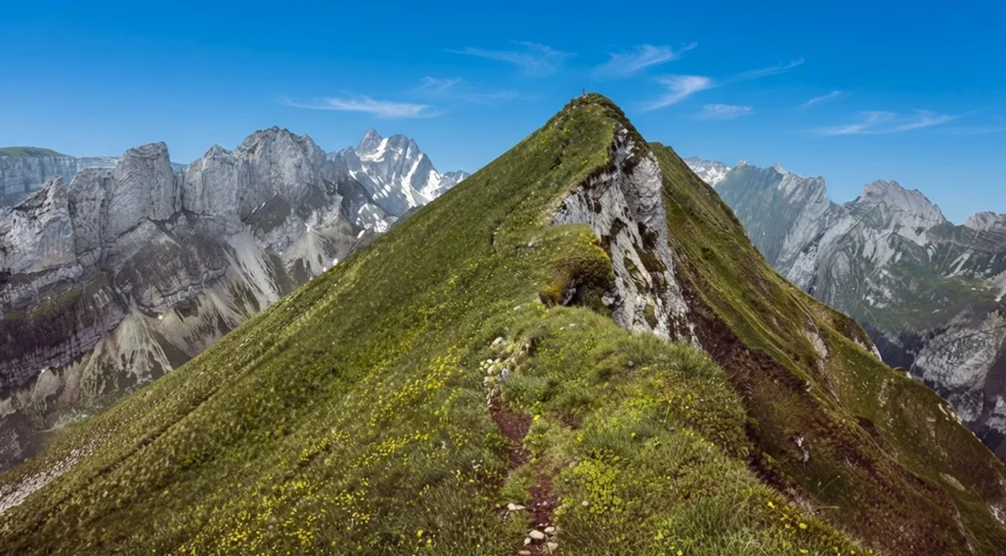
Eventually, the path swings left and climbs onto the spine of Marwees. The eastern summit awaits at 1991 meters, marked by a simple cross, a bench, and trail signs pointing onward. Here, the panorama unfurls in full: Widderalp Valley tucked beneath serrated ridges, Seealpsee glimmering turquoise below, and the Alpstein chain stretching in every direction.
The summit is not only a destination but a pause, a place to breathe deeply and absorb the immensity of the landscape.
Walking the Ridge
The ridge itself is the heart of the hike. Narrow, exposed, and exhilarating, it demands focus but offers pure joy in return. To the north, Schäfler and Säntis rise in solemn procession; to the south, Hundstein and Altmann pierce the sky. The trail skirts rugged descents, requiring balance and care, before easing toward Widderalpsattel, the saddle between Marwees and Hundstein.
There is no marked way to the western summit, but the ridge itself is the prize, a walk suspended between valleys, each step carrying you deeper into the Alpstein’s core.
Descent to Meglisalp
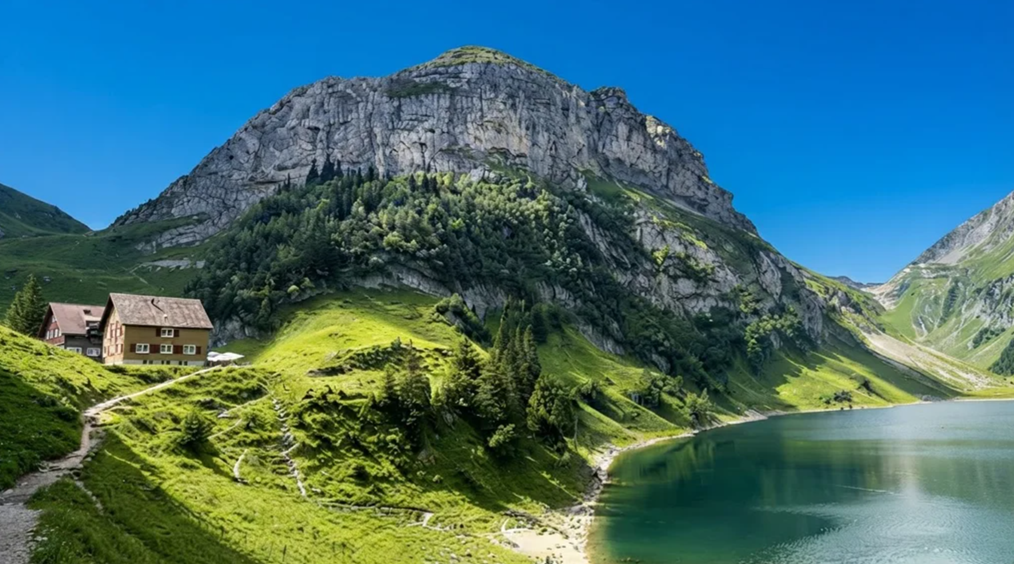
From Widderalpsattel, the trail softens, winding down toward Meglisalp, a mountain pasture where huts cluster against cliffs and the air carries the scent of alpine herbs. Lunch here feels earned — cheese and bread, perhaps, with the valley spread below and the ridge now behind you.
Meglisalp is more than a rest stop; it is a reminder of the human presence in the Alps, a place where tradition and landscape meet.
The Shores of Seealpsee
Beyond Meglisalp, the path drops toward Seealpsee, its waters catching late-afternoon light. A wide trail circles the lake, reflections of Marwees shimmering on the surface, before the final stretch returns you to Wasserauen. The lake is a fitting conclusion, a mirror that gathers the day’s journey into a single image: ridge and valley, summit and pasture, all reflected in turquoise calm.
The Demands of the Trail
The statistics of the hike tell part of the story: 14.5 kilometers, nearly seven hours, 1225 meters of elevation gain, a difficulty rating of T3. But numbers alone cannot capture the essence of Marwees. This is a trail that demands respect, not only for its steepness and exposure but for its capacity to transform a day into an experience that lingers long after.
The ridge is not the most difficult in the Alps, but it is among the most rewarding, offering a dialogue with altitude, a walk between valleys, and a view that gathers the entire massif into a single sweep.
Weather and Conditions
Marwees is best tackled in dry, stable weather, when the ridge is firm underfoot and the sky clear enough to reveal the full breadth of the Alpstein. In rain, the path becomes treacherous, its narrow spine slick and unforgiving. But in good conditions, the hike is unforgettable, a journey that begins in the bustle of Wasserauen and ascends into solitude, where the only sounds are wind, cowbells, and the crunch of boots on stone.
Contrasts and Character
The character of the hike lies in its contrasts. The gentle meadows of the lower trail give way to the sharp ascent of Bogartenlücke. The enclosed forest opens into the vast panorama of the ridge. The exertion of the climb dissolves into the quiet joy of walking the spine of Marwees, where valleys fall away on either side and the horizon stretches unbroken.
The descent to Meglisalp and Seealpsee brings the hike full circle, returning you to water and pasture, but with the memory of altitude still fresh.
To walk Marwees is to trace a narrative written in stone and grass, a story that begins in the valley and rises into the sky. It is not simply a hike but an immersion into the Alpstein, a way of seeing the massif from within, of feeling its scale and its intricacy.
The ridge is narrow, the path demanding, but the reward is vast — a panorama that gathers the Alpstein into a single vision, a memory that endures long after the descent.
Closing Reflection
For those who seek both challenge and beauty, the Marwees Ridge Trail stands as one of the finest day hikes in Appenzell. It is a journey that requires strength and caution, but offers in return a view that is both intimate and immense, a walk that feels less like a route and more like a revelation.