
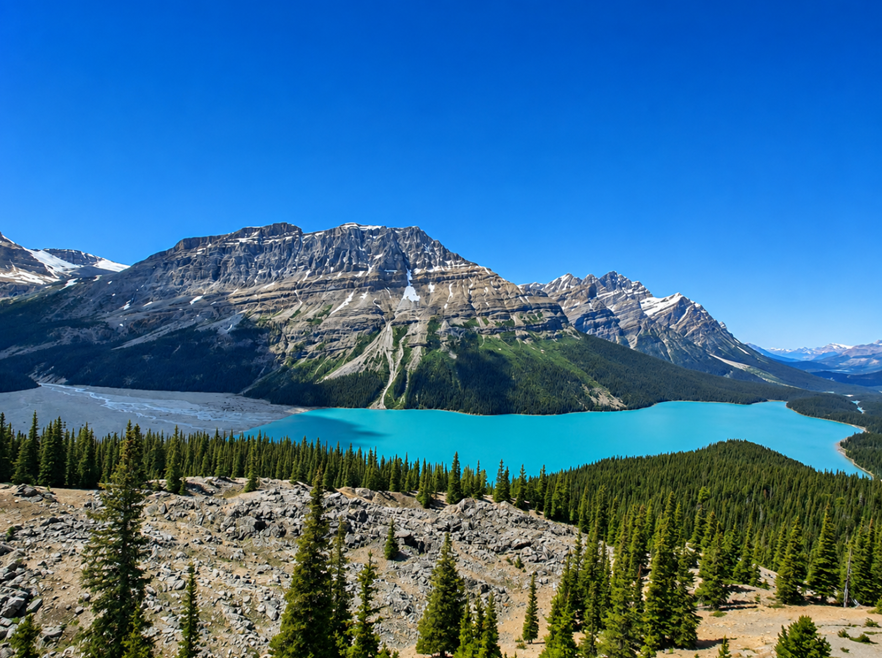
Peyto Lake is more than a landmark; it is a vision that feels almost imagined, a turquoise expanse shaped like the head of a wolf gazing across the Canadian Rockies. At 1,860 metres above sea level, it lies cradled beneath the Bow Summit, its colour so vivid it seems digitally enhanced.
The secret lies in glacial rock flour—fine particles carried by meltwater from the Peyto Glacier, suspended in the lake and refracting sunlight into an electric blue-green glow. This phenomenon peaks in summer, when the glacier’s meltwater flows strongest, turning the lake into a jewel that dazzles beneath the alpine sky.
Named after Bill Peyto, a legendary Banff guide and trapper of the early 1900s, the lake carries both history and spectacle, a place where human stories meet geological wonder.
Journey Along the Icefields Parkway
The approach to Peyto Lake is a pilgrimage along one of the world’s most scenic drives. The Icefields Parkway, Highway 93 North, unfurls like a ribbon through towering peaks and sweeping valleys. From Banff townsite, the journey takes about one hour and fifteen minutes, passing Lake Louise before climbing toward Bow Summit.
Each curve of the road reveals new drama—glaciers clinging to mountainsides, rivers carving through limestone, forests stretching endlessly. The anticipation builds as the Parkway rises to its highest paved point, 2,088 metres above sea level, where the Bow Summit turnoff signals the gateway to Peyto Lake.
For those who arrive early, the road feels hushed, the morning light softening the peaks, and the promise of turquoise water waiting just beyond the trees.
Trails to the Viewpoints
The Bow Summit Lookout Trail is short yet transformative. A paved boardwalk leads through subalpine forest, fir and spruce rising tall, their scent sharp in the cool air. The trail climbs gently, about 100 metres of elevation, before opening onto the main platform.
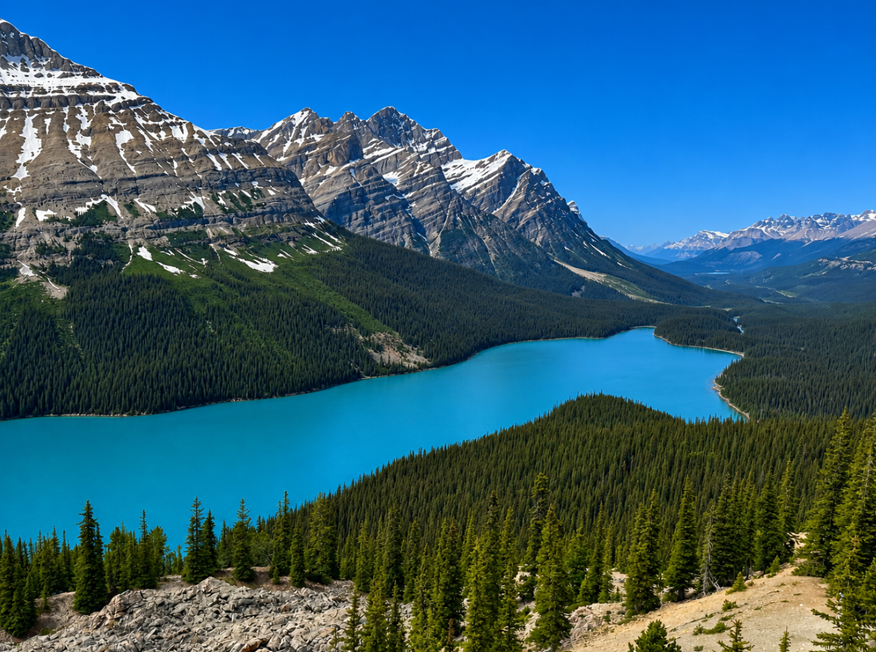
Here, the lake stretches below in its full wolf-head shape, framed by the Mistaya Valley and distant peaks. The view is unobstructed, a panorama that feels both intimate and vast. For those seeking solitude, the Upper Viewpoint Trail extends further, climbing rocky terrain to a ridge above the main platform.
The ascent adds another kilometre each way, but the reward is a sweeping perspective—Peyto Lake glowing below, Bow Lake shimmering to the south, glaciers gleaming on all sides. Sturdy boots are essential, as the path grows uneven, but the silence at the ridge is profound. Fewer visitors make the climb, leaving the air filled only with wind and the distant cry of birds.
Photography in Shifting Light
Light transforms Peyto Lake into different worlds. At sunrise, the valley glows gold, mist rising from the surface, curling like smoke across the turquoise water. The lake faces east-southeast, so the morning sun falls directly onto its surface, illuminating the wolf-head outline with warmth.
Photographers linger here, polarising filters ready, capturing the drama of mist and colour. Sunset brings a different magic. The lake often falls into shadow, but the peaks to the east ignite with alpenglow, their ridges painted pink and orange against the fading sky.
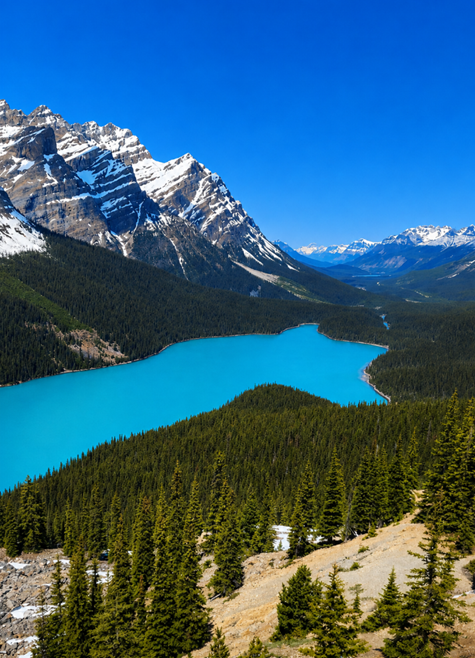
The drive back along the Parkway becomes its own spectacle, the evening light softening every curve of the road. For pure photography, sunrise holds the edge, but sunset offers a more relaxed, contemplative experience. Even cloudy days bring their own gift—the turquoise appears deeper, shadows softened, the colour more saturated.
Peyto Lake is never static; it is a canvas that shifts with the sky.
Seasons of Transformation
Peyto Lake is not one landscape but many, each season reshaping its character.
Spring brings thawing ice and lingering snow. The Bow Summit trail may still hold patches of frost, the lake beginning to shed its winter shell. The colour is muted, not yet at peak vibrancy, but the solitude is profound. Few visitors come at this time, leaving the forest quiet, the air crisp, and the lake a pale reflection of what is to come.
Summer ignites the lake into brilliance. From late June to early September, glacial meltwater flows strongest, turning the water into an almost electric turquoise. Crowds gather, drawn by the spectacle, but the colour is worth the company. Wildflowers bloom along the trail, adding bursts of yellow and purple to the alpine palette.
Autumn drapes the hillsides in golden larch, the lake’s colour softening but still striking. The crowds thin after Labour Day, leaving the viewpoints calmer. The contrast of gold against turquoise creates one of the Rockies’ most beautiful scenes, a fleeting moment before winter arrives.
Winter transforms Peyto into silence. The lake freezes, snow blankets the forest, and the trail requires snowshoes or winter hiking skill. The Bow Summit road remains open most winters, but conditions can change quickly. For those who venture here, the reward is a crystalline world, the wolf-head shape hidden beneath snow, the air sharp and still.
Practical Wisdom for Visitors
Facilities at Bow Summit are simple—washrooms, boardwalks, viewing platforms—but no shops or cafes. Visitors must bring water, snacks, and sun protection. Parking operates on a first-come basis, and in July and August the lot fills by mid-morning. Arriving before 8 AM ensures both a space and a quieter experience.
Crowds peak between 10 AM and 3 PM, so early mornings or late afternoons are best. Accessibility is good for the main boardwalk, suitable for moderate mobility, though the upper trail is rocky and uneven. Wildlife roams the forest—grizzly bears, black bears, wolves, elk—reminders that this is their home first.
Bear spray, group travel, and respect for distance are essential.
Pairing Peyto with Other Wonders
The Icefields Parkway is a corridor of marvels, and Peyto Lake shines brightest when paired with its neighbours.
Bow Lake lies just south, a wide glacial expanse reflecting Crowfoot Glacier. Its shoreline is easily accessible, perfect for a quiet pause.
Mistaya Canyon offers a short walk to a limestone gorge carved by meltwater, its rushing waters echoing through stone.
Saskatchewan River Crossing provides a practical stop for fuel and food, but also a sweeping view of the North Saskatchewan River valley.
Columbia Icefield and Athabasca Glacier extend the journey north into Jasper, where visitors can step onto ancient ice.
Together, these stops form a tapestry of landscapes, each distinct yet connected, with Peyto Lake as the jewel at the centre.
The Verdict: Timeless Beauty
In 2026, Peyto Lake remains one of Canada’s most breathtaking viewpoints. Its accessibility, dramatic elevation, and extraordinary colour make it unforgettable. Whether at sunrise with mist curling across the valley, or at sunset with alpenglow painting the peaks, Peyto Lake rewards those who plan carefully and arrive with reverence.
It is not simply a stop along the Parkway—it is a moment where nature feels larger than life, a turquoise wolf-head gazing eternally across the Rockies. For travellers seeking both spectacle and serenity, Peyto Lake offers both, a timeless beauty that lingers long after the journey ends.