

Airport Link
Ottawa’s airport link, the O‑Train Line 4, is more than a transit corridor. It is a symbolic passageway, a thread that ties the international gateway of Macdonald‑Cartier International Airport to the pulse of the city. For travelers arriving in Canada’s capital, the line offers not just transport but a first impression: a glimpse of Ottawa’s ambition to weave modern infrastructure into its urban fabric.
The Gateway: Airport Station
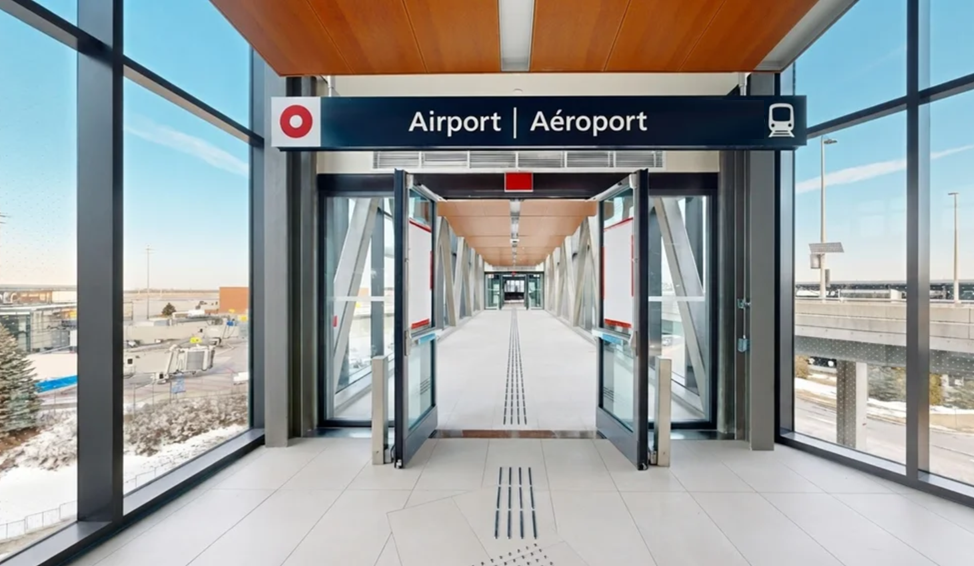
The journey begins at Airport Station, a modest yet purposeful structure positioned just outside the terminal. Its design is utilitarian, glass panels reflecting the sky, steel beams anchoring the space in quiet strength. Unlike the grandeur of Toronto’s Union Station or the historic charm of Montreal’s Gare Centrale, Airport Station is understated.
It is not meant to impress but to function, to shepherd passengers from baggage claim to train carriage with minimal friction. Here, the traveler senses Ottawa’s pragmatism. The station is compact, easy to navigate, and deliberately simple. For the weary flyer, this is a relief: no labyrinthine corridors, no confusing signage. Instead, a direct path from arrival hall to platform, a gesture of welcome that prioritizes clarity over spectacle.
Service Hours: Rhythm of the Day
Operating from 5:59 a.m. until midnight, Line 4 mirrors the rhythm of the airport itself. Early morning flights from Europe find their passengers stepping onto the platform just as the first trains vibes into service. Evening arrivals from Vancouver or Calgary are still accommodated, the line carrying travelers northward until the city begins to sleep.
Yet the midnight cutoff is telling. Ottawa, unlike New York or London, is not a city that thrives in perpetual motion. It rests, and so does its transit. For those arriving in the deep hours of night, taxis and rideshares remain the only companions. The absence of a 24‑hour service speaks to Ottawa’s scale: a capital city, yes, but one that retains the cadence of a smaller community.
The Route: Airport to South Keys
From Airport Station, the train glides northward to South Keys Station, a junction where Line 4 hands passengers to Line 2, Ottawa’s broader light rail corridor. This connection is the heart of the system’s logic. The airport is not an isolated endpoint but a tributary feeding into the city’s transit river.
South Keys itself is a neighborhood of contrasts: commercial plazas, residential streets, and the vibes of traffic along Bank Street. The station here is more than a transfer point; it is a threshold between the airport’s global arrivals and Ottawa’s local life.
Travelers step off Line 4 and onto Line 2, suddenly immersed in the city’s daily rhythm. Students, commuters, and families mingle with visitors, the distinction between tourist and resident dissolving in the shared space of the platform.
Fare Integration: The Democratic Ticket
At CAD $3.75, the fare is identical to that of Ottawa’s buses. This is not a premium airport surcharge, not a tourist tax disguised as convenience. It is a statement of integration: the airport is part of the city, and its transit should be priced as such. Payment is straightforward. A Presto card taps against the reader, exact change slips into the fare box, or a mobile ticket flashes on a screen.
For newcomers, this simplicity is invaluable. There is no need to decipher a separate system, no hidden fees lurking in fine print. The O‑Train is democratic, its accessibility woven into the very structure of its fare.

Best For: The Traveler’s Choice
Line 4 is not the fastest way downtown. Taxis and rideshares cut the journey to 20 minutes, while the train requires a transfer and a longer ride. Yet speed is not its selling point. The Airport Link is best for those who value connectivity over immediacy.
Students returning from holidays, budget‑conscious travelers, and visitors with light luggage find in Line 4 a reliable companion. It is predictable, immune to traffic jams, and embedded in the city’s transit grid. For those whose destinations lie along Line 2, the train is not merely convenient—it is logical.
Traveler Suitability: Who Benefits Most
The Airport Link serves distinct groups with particular efficiency:
Students: Affordable fares and direct connections to Line 2 make it ideal for those commuting to universities and colleges.
Budget Travelers: At less than CAD $3.90, it is the cheapest way into the city, a fraction of taxi or rideshare costs.
Light Luggage Passengers: The train’s design favors those who can move easily; heavy suitcases are less suited to its platforms and transfers.
Eco‑Conscious Visitors: Rail transit reduces carbon footprint, aligning with sustainable travel values.
For business travelers on tight schedules, taxis remain superior. For families with children and multiple bags, private transfers offer comfort. But for the solo traveler, the student, or the visitor seeking immersion in local life, Line 4 is the most authentic choice.

Challenges and Limitations
Line 4 is not without flaws. Its limited hours exclude late‑night arrivals. Its reliance on transfers slows the journey. Its modest scale leaves it vulnerable to crowding during peak times. Yet these limitations are not failures but reflections of Ottawa’s reality.
The city does not demand a 24‑hour express line; it requires a functional, affordable connection. Line 4 delivers precisely that.
The O‑Train Line 4 Airport Link is not the fastest, nor the grandest, nor the most luxurious. It is, instead : practical, modest, reliable. For travelers who value connection over speed, affordability over convenience, and immersion over isolation, it is the perfect choice.