
English Bay is more than a beach. It is Vancouver’s living postcard, the place where the city meets the ocean in a sweep of sand, skyline, and sunset. Known formally as English Bay Beach—or simply “First Beach” to locals—it sits at the western edge of downtown, pressed against the West End and opening out toward the horizon.
It is here that Vancouver slows down, where the seawall empties its endless stream of walkers and cyclists, and where the day concludes in colour.
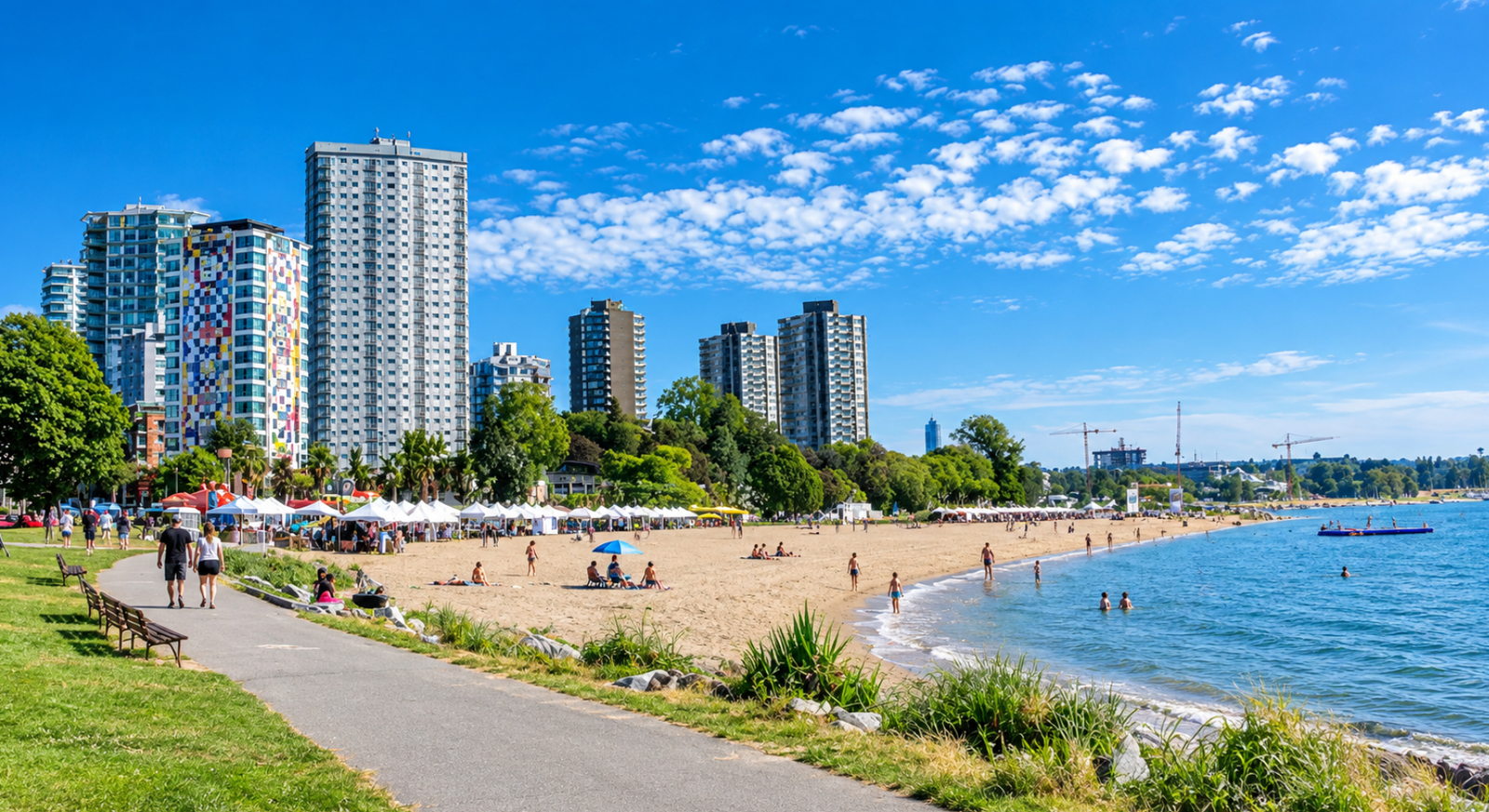
The Curve of the Shoreline
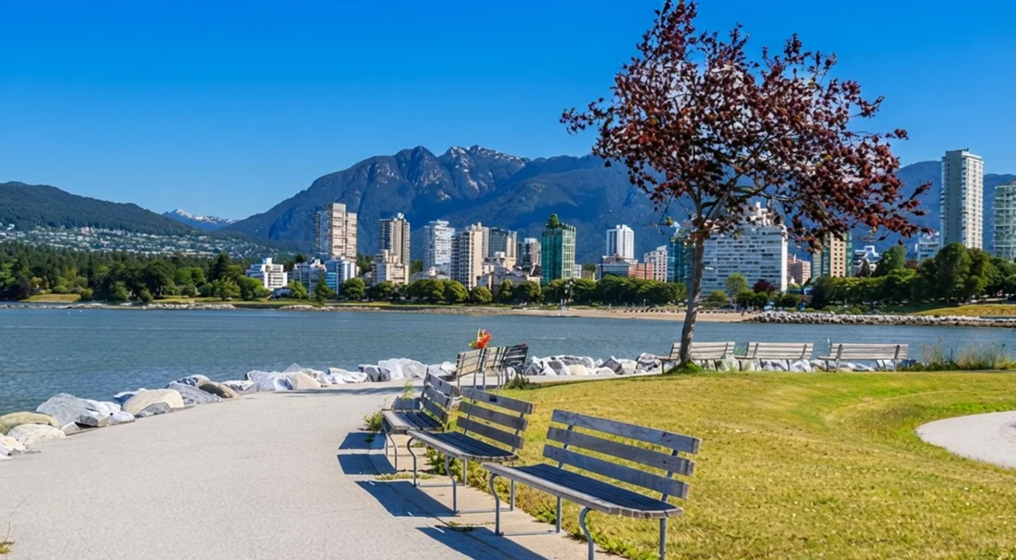
English Bay’s geography is deceptively simple: a crescent of sand framed by grass, seawall, and towers. Yet this curve is the city’s most recognizable gesture, a natural amphitheatre where people gather to watch the ocean perform. The sand itself is a mix of dark grey and pale grains, warming quickly under summer sun, cooling into damp firmness in winter.
It is not the endless expanse of Spanish Banks, nor the intimate cove of Third Beach, but something in between—a stage for the city’s collective life.
The Seawall’s Crescendo
The Stanley Park Seawall is one of Vancouver’s defining features, a continuous waterfront path that loops around the park and threads through the city. English Bay is its crescendo. Cyclists coast to a stop, rollerbladers unbuckle their gear, walkers pause to breathe in the salt air.
The seawall funnels energy into the beach, and the beach releases it back into the ocean. It is a rhythm that repeats daily, a ritual of movement and pause.
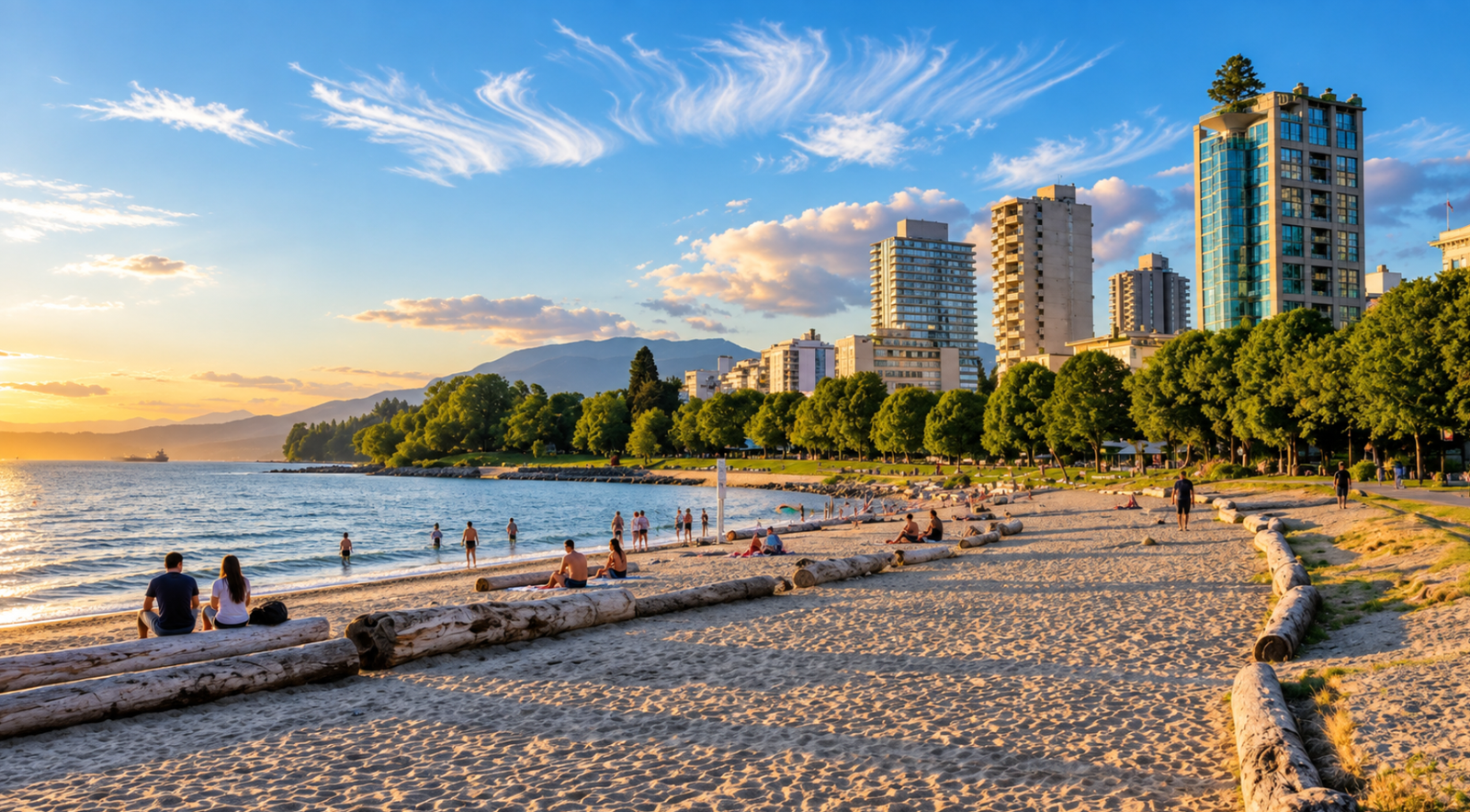
The Sunset Theatre
English Bay is Vancouver’s sunset theatre. Each evening, the sky transforms into a canvas of orange, pink, and violet, mirrored in the water’s surface. Crowds gather along the shoreline, cameras poised, conversations hushed. Photographers crouch in the sand, and children chase shadows as the light fades. No two sunsets are alike, and yet each feels inevitable, as if the day must end here.
Festivals of Fire and Ice
English Bay is not only a place of quiet ritual but also of grand spectacle. Each January, the Polar Bear Swim plunges thousands into icy waters, a tradition that shocks the body awake and binds the city in laughter. In summer, the Celebration of Light ignites the sky with fireworks, drawing crowds that spill across the sand and seawall.
These events transform the beach into a carnival of colour, moments when Vancouver’s collective spirit is most visible.
Everyday Traditions
Beyond festivals, English Bay thrives on small traditions. Volleyball games unfold on sand courts, with nets borrowed from lifeguards and balls thudding against palms. Kayaks and paddleboards skim across the water, their silhouettes sharp against the horizon.
Dogs tug at leashes, children dig trenches in the sand, and picnickers spread blankets across the grass. The concession stands vibes with activity, while the Cactus Club Cafe offers a more refined perch above the beach. These rituals are the heartbeat of the bay, ordinary yet essential.
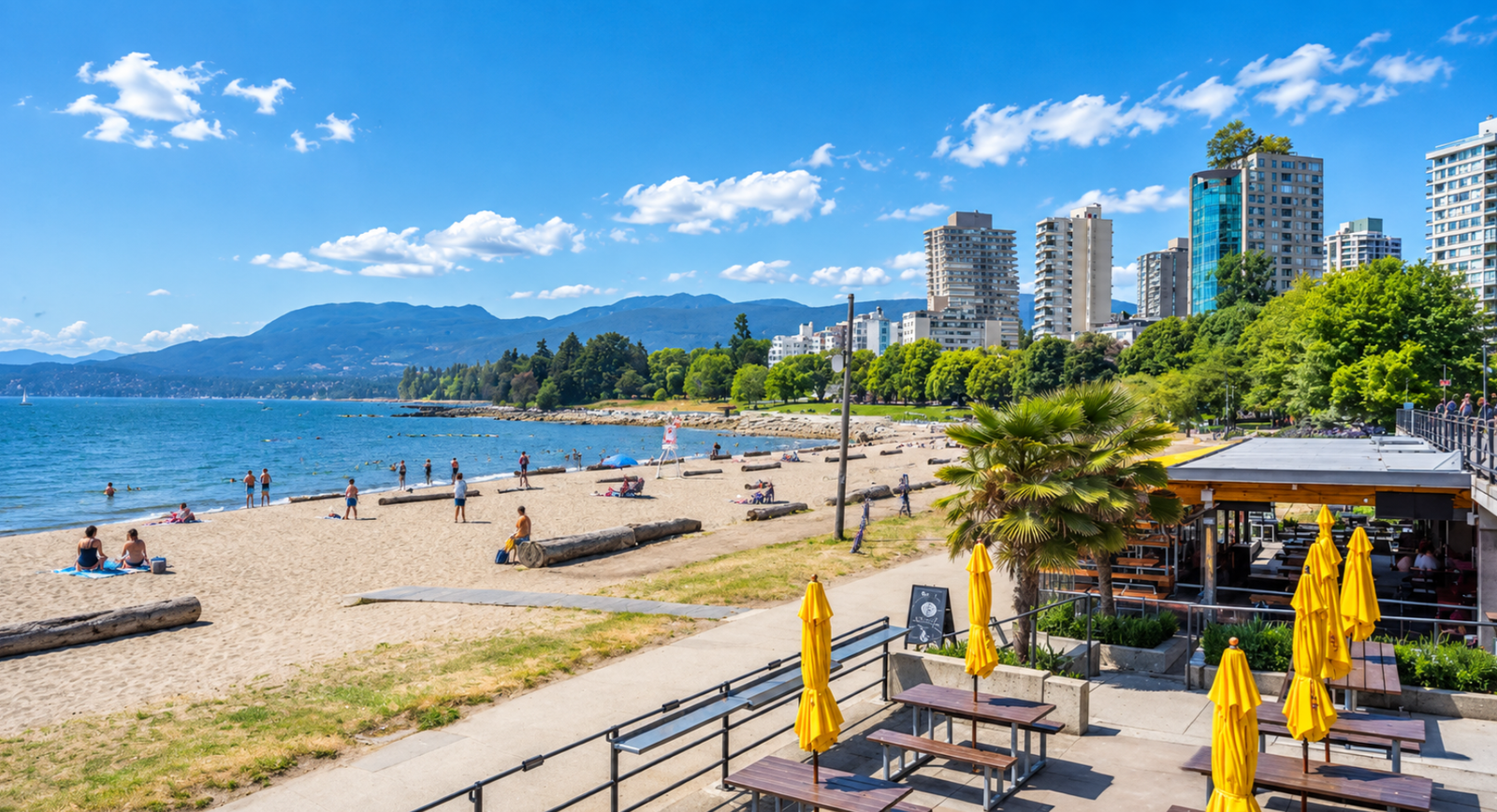
The Architecture of Atmosphere
English Bay is framed not only by sand and sea but also by architecture. The art deco bathhouse, with its curved lines and pale facade, recalls an earlier era of leisure. Towers rise behind the beach, their glass reflecting the ocean’s shifting colours. Denman Street funnels energy into the bay.
The juxtaposition is striking: urban density pressed against natural openness, a collision that defines Vancouver itself.
Comparisons and Contrasts
English Bay is beloved, yet it is also contested. Compared to Kitsilano, it lacks expansive lawns and nearby pools. Compared to Jericho, it offers fewer opportunities for sailing and open-water play. Compared to Spanish Banks, its tide does not retreat into vast flats of sand.
And yet, English Bay remains essential—not for its amenities, but for its atmosphere. It is the city’s front door, the place where Vancouver greets the ocean and the ocean greets Vancouver.
Hidden Corners
For those who seek respite from crowds, Sunset Beach lies just a short walk away, quieter and more contemplative. Beach Avenue offers a gentler promenade, where footsteps replace the rush of wheels. These hidden corners extend the experience of English Bay, offering balance to its vibrant energy.
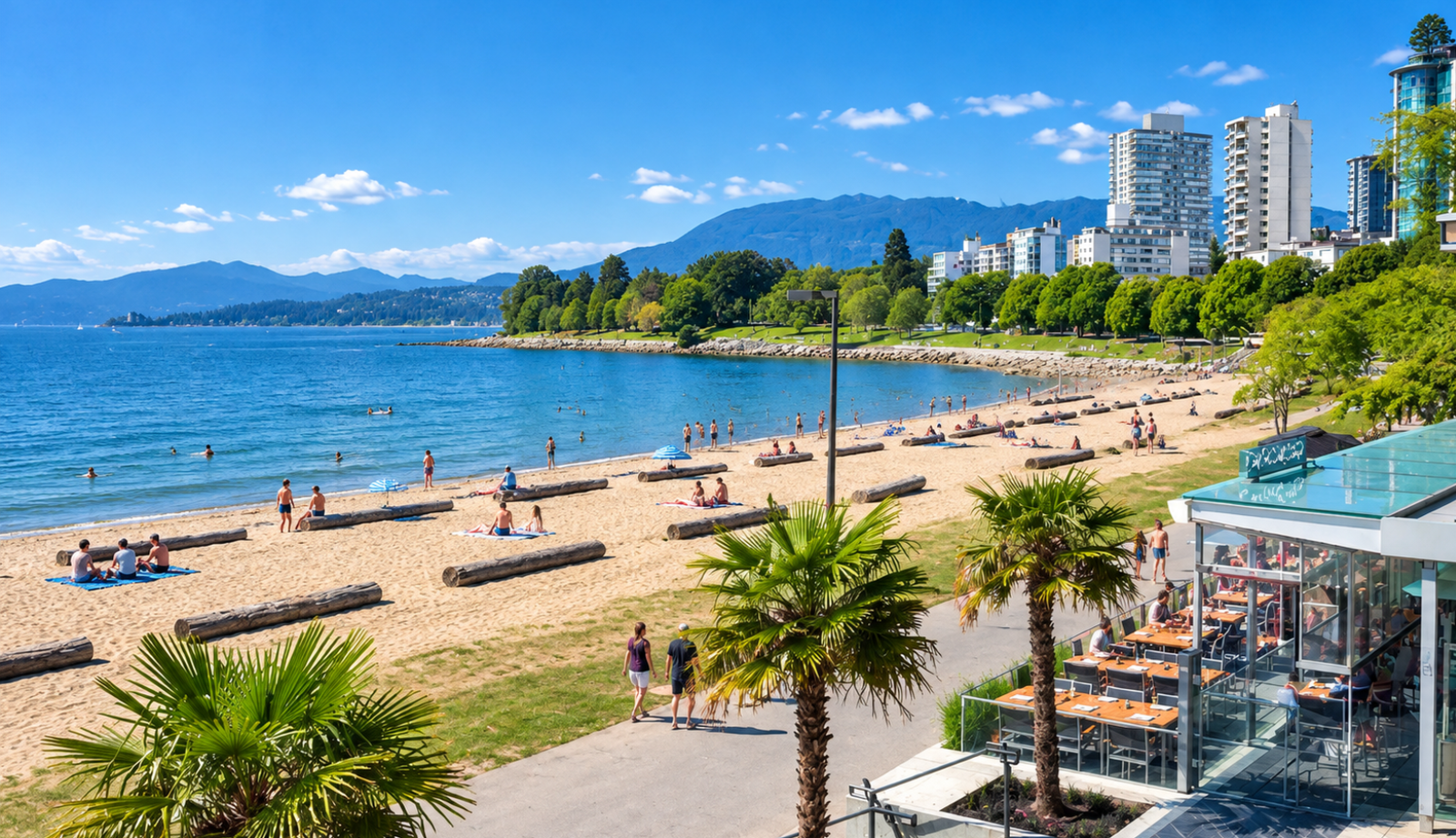
Seasonal Shifts
English Bay changes with the seasons.
Spring brings mild weather and blooming flowers, with fewer crowds and a sense of renewal.
Summer is peak season, alive with festivals, volleyball games, and swimmers plunging into warm waters.
Autumn calms the atmosphere, sunsets deepening in colour as the air cools.
Winter quiets the beach, transforming it into an extended backyard for West End residents, a place for contemplative walks and storm watching.
Each season reshapes the bay, yet its essence remains constant: a meeting of city and sea.
The Practicalities of Play
English Bay is equipped for leisure, though modestly. Public washrooms, concession stands, and rentals for umbrellas and chairs provide convenience. Lifeguards watch over swimmers from late May to early September. A mobi-mat accessible pathway ensures inclusivity, while water wheelchairs allow access to the shoreline.
A swimming raft with a slide offers playful escape, and volleyball courts invite casual competition. These facilities are functional rather than extravagant, reinforcing the beach’s role as a communal space rather than a resort.
Safety and Simplicity
English Bay is safe, though discretion is always advised. Swimming is best in July through September, when lifeguards are present and the water warms. Dogs are welcome but must remain leashed, with an off-leash area tucked beneath the bridge.
Parking is limited to meters along Davie and Denman Streets, encouraging visitors to arrive by transit, bike, or foot. The simplicity of these rules reflects the beach’s character: open, accessible, and communal.
The Spirit of the West End
English Bay is inseparable from the West End. The neighbourhood’s density pours into the beach, creating a vibrant energy that is both local and global. Tourists mingle with residents, students with retirees, families with solo wanderers. The beach is a shared backyard, a communal living room, a stage for the city’s diversity.
It is this spirit that makes English Bay more than sand and water—it is a reflection of Vancouver itself.
The Critic’s View
Some argue that English Bay is the least essential of Vancouver’s beaches. Its sand is darker, its amenities fewer, its crowds heavier. Compared to other beaches, it suffers in variety and space. Yet these critiques miss the point. English Bay is not about solitude or expansiveness; it is about atmosphere.
It is the place where the city gathers, where energy concentrates, where sunsets conclude the day. Its value lies not in comparison but in presence.
The Postcard Image
English Bay is Vancouver’s postcard image, the one that appears in travel guides and promotional videos, the one that locals and visitors alike recognize instantly. It is the Eiffel Tower of Vancouver, the Parliament Hill of the Pacific coast. To describe it is almost redundant, for everyone has seen it, whether in person or in picture.
Yet to experience it is always new, always alive, always essential.
The Meeting of City and Sea
English Bay is where Vancouver exhales. It is where the skyline bends toward the ocean, where the seawall concludes in sand, where the day ends in colour. It is not the quietest beach, nor the most spacious, nor the most varied. But it is the one that belongs to everyone.
It is the city’s front door, its living postcard, its sunset theatre. To stand on its sand is to feel Vancouver’s pulse, reflected in the tide.