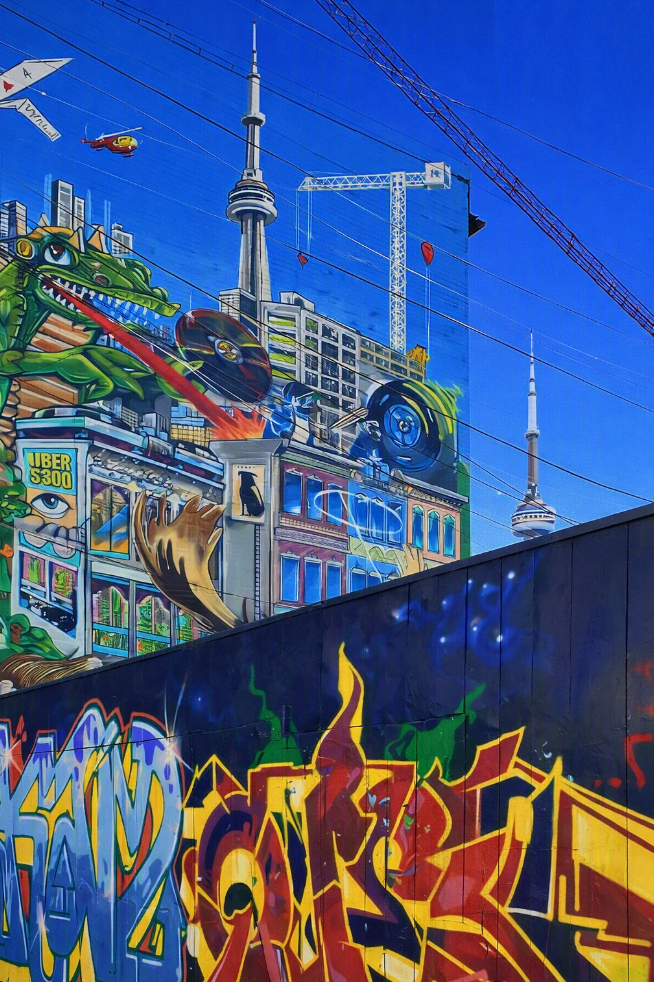
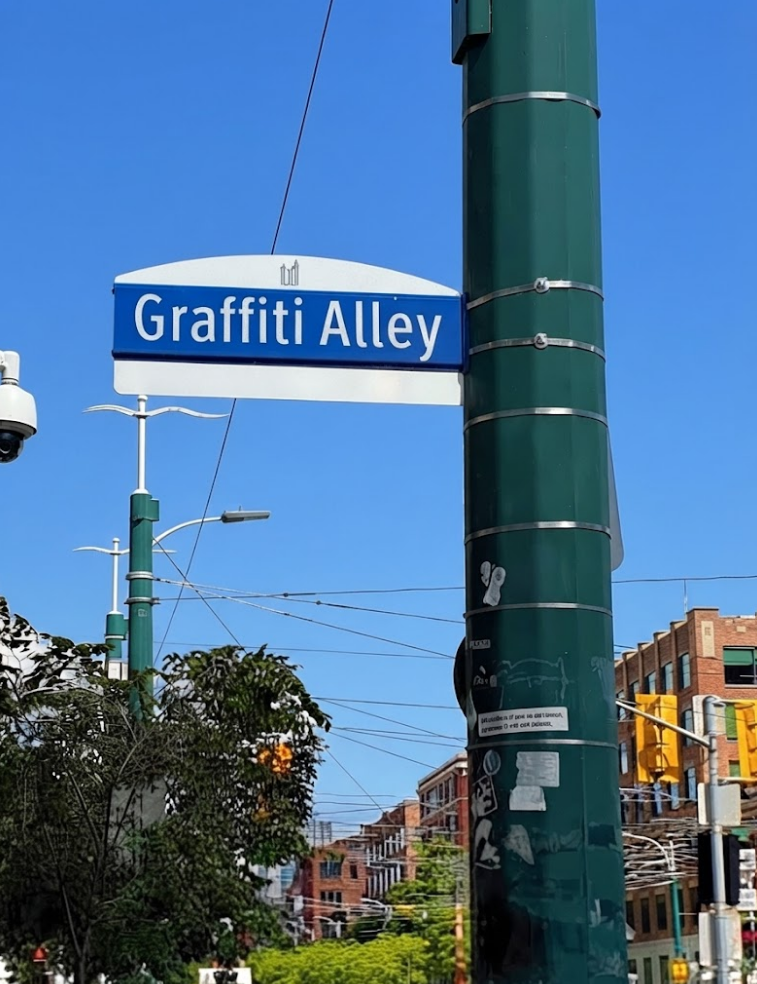
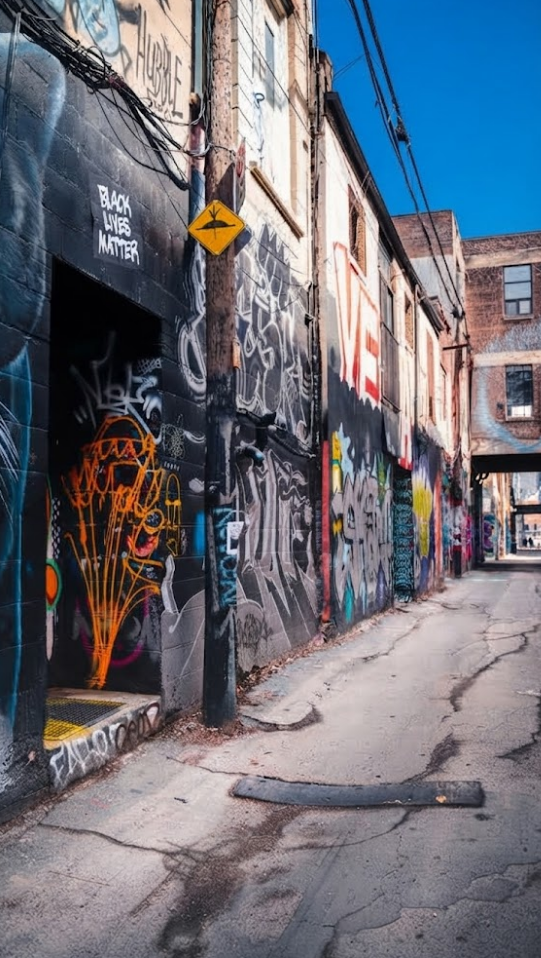
Graffiti Alley is not simply a laneway in Toronto. It is a living canvas, a place where the city breathes in colour and exhales stories. Step off Queen Street West and the rhythm of Toronto changes. The hum of traffic softens, brick walls bloom with paint, and the air feels charged with possibility.
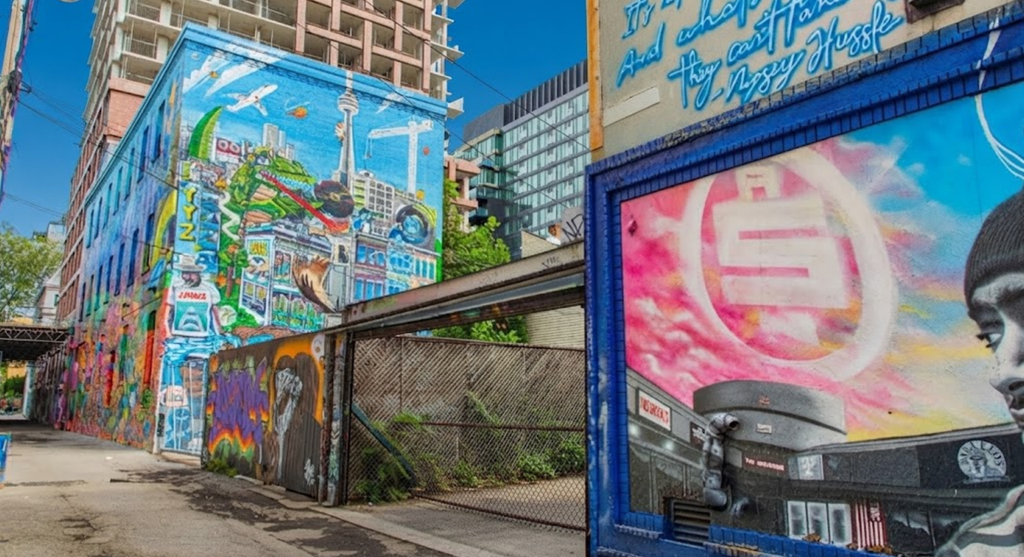
This stretch of Rush Lane, running just south of Queen between Spadina Avenue and Portland Street, has become one of the city’s most beloved attractions. To walk its length is to wander through Toronto’s collective imagination. Murals rise high, tags twist into wild shapes, and portraits stare back with quiet intensity. Every wall speaks, and every visit feels different.
A Place of Discovery
Graffiti Alley is more than decoration. It is Toronto speaking in layers—local history, breaking news, tributes, jokes, grief, joy. The alley runs for nearly 500 metres, but the art spills outward into side lanes and hidden corners. Following the paint becomes a kind of pilgrimage, each mural a marker of the city’s evolving voice.
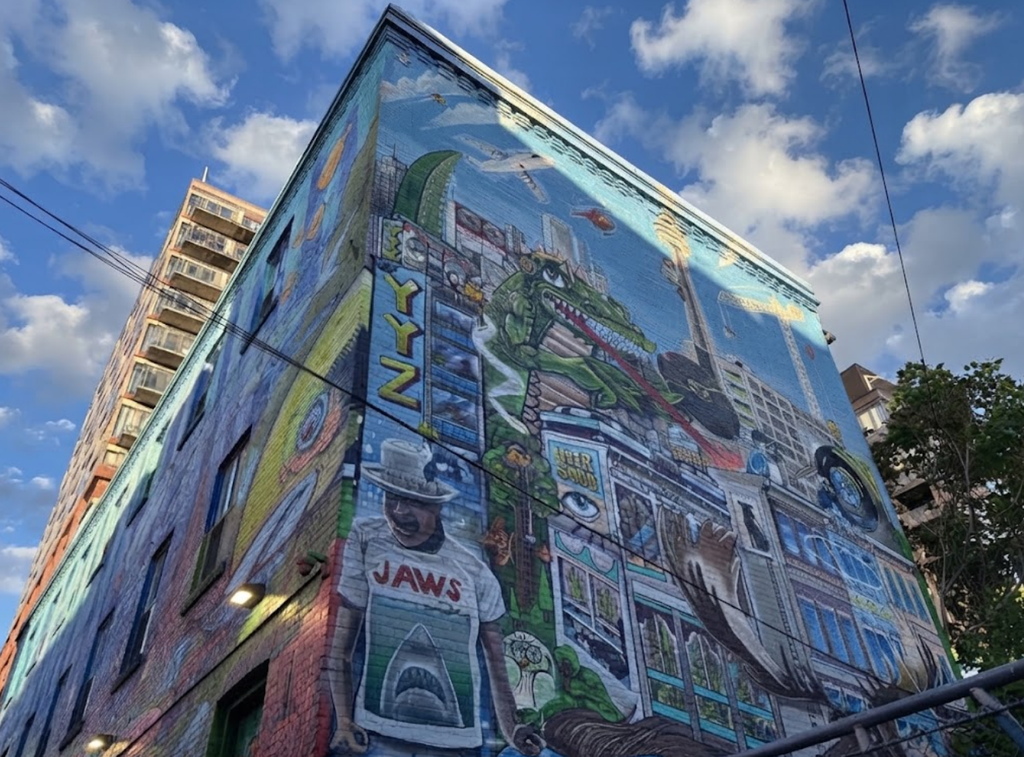
The entrance sits just south of Queen and Spadina. At first glance, the corner may seem ordinary, but walking west reveals walls that grow louder, brighter, more intricate. Murals stretch high, raccoons grin back, canary-yellow birds perch in clusters, and Toronto’s icons—the Ikea Monkey—hide in Uber5000’s sprawling “Toronto Tribute.” Painted in 2017, it is a living Where’s Waldo of the city’s soul.
From Vandalism to Significance
Toronto has not always known what to do with graffiti. For decades, the debate blurred between vandalism and art. In 2011, City Council designated Graffiti Alley “an area of municipal significance” as part of its Graffiti Management Plan. This decision gave artists freedom to claim the space, and businesses freedom to embrace it without fear of erasure.
Rick Mercer, a beloved Canadian comedian, brought Graffiti Alley to national attention when he used it as the backdrop for his weekly televised rants. Suddenly, millions of viewers saw Toronto’s walls as more than scribbles—they were a stage, a voice, a character in the city’s story.
A Rallying Ground
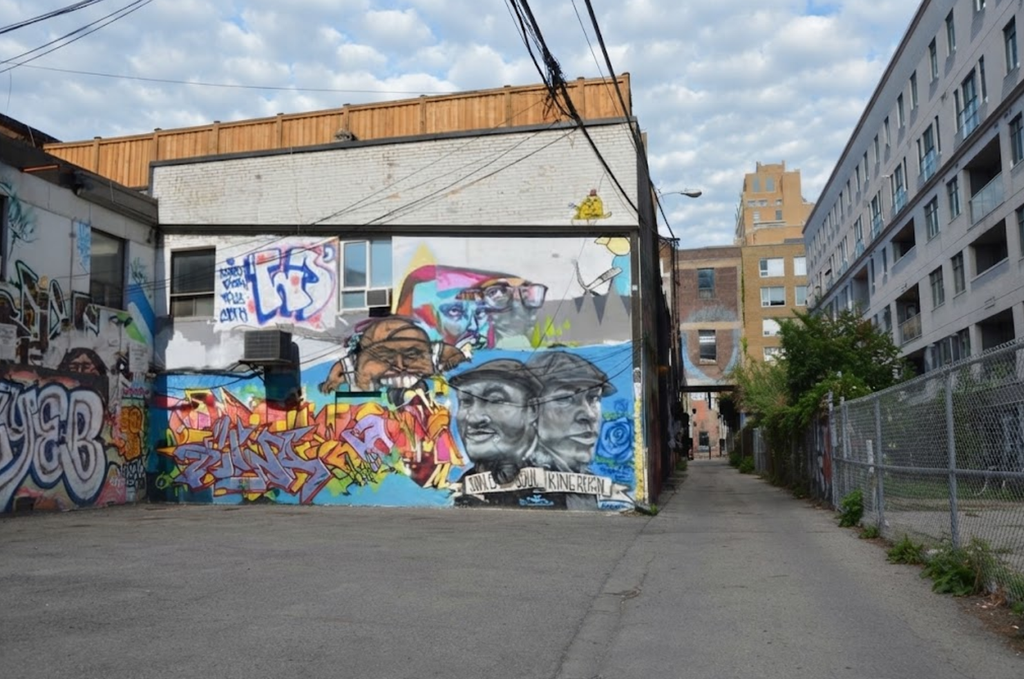
Graffiti Alley has always been more than decoration. In the summer of 2020, artists gathered to honour George Floyd, Breonna Taylor, and civil rights leaders. Black-and-white portraits filled the walls, transforming the alley into a protest, a memorial, a call to conscience.
For weeks, the space carried grief and solidarity, and even now, fragments of those works remain. The alley often becomes a site of tribute. Portraits of lost rappers, artists, and community members appear, names painted with reverence. Each mural is both remembrance and resistance, proof that art can hold memory in public view.
How Long to Stay
Time spent here depends on curiosity. The entire stretch can be walked in ten minutes, but lingering for an hour reveals hidden details—side passages, layered tags, artists at work. Some visitors come for a single photo, others wander slowly, tracing the walls like pages in a book.
The alley is safe, though shadows and garbage bins remind visitors it remains a working back lane. Guided tours offer deeper context, introducing the names behind the paint and the stories behind the walls.
What You’ll See
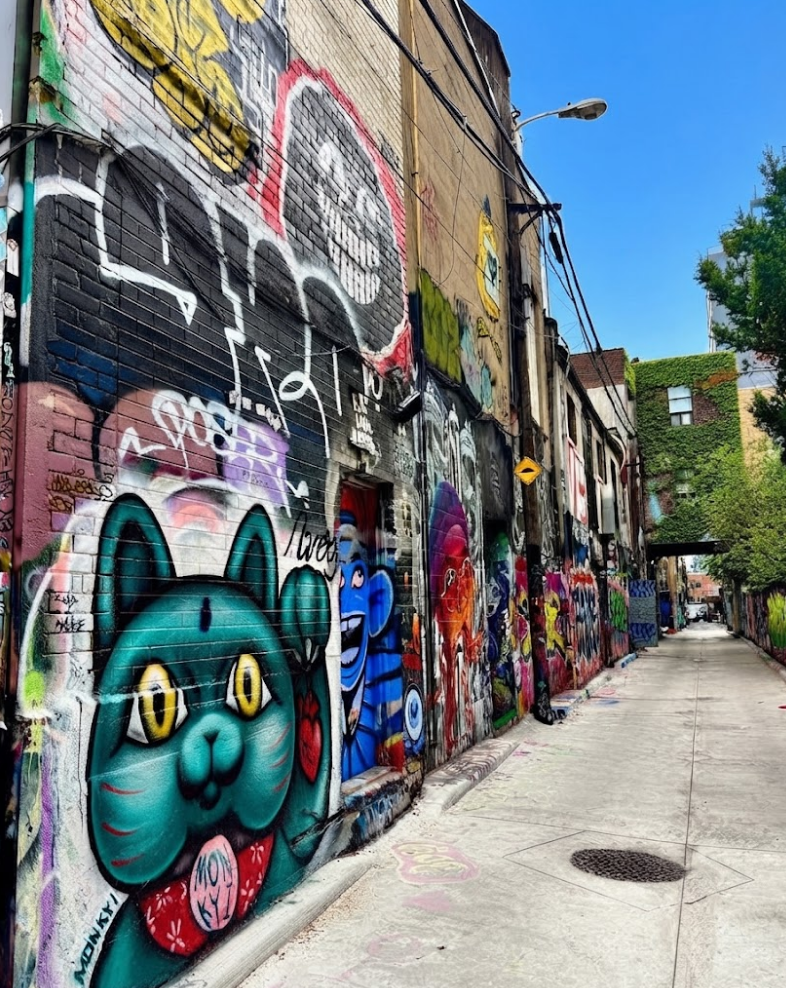
Graffiti Alley is a kaleidoscope of styles. Elaborate 3-D tags twist into wild shapes, wheat paste posters peel at the edges, stickers cluster on poles, and stencils leave sharp silhouettes. Yet what stands out most are the murals. The murals tell Toronto’s story. Raccoons, the city’s unofficial mascots, grin from walls. Blue Jays mascots leap in bright colours.
Uber5000’s yellow birds perch everywhere, playful and persistent. His “Toronto Tribute” mural remains a favourite, a puzzle of faces and icons that rewards careful looking. Street art here is respected. Prime pieces are rarely covered, and artists often layer new work without erasing the old. The alley is constantly changing, but it carries continuity—a dialogue across time.
Seasons of Colour
Graffiti Alley can be visited year-round, but the experience shifts with the seasons. In summer, sunlight spills across the walls, and the alley hums with photographers, tourists, and locals. In winter, snow muffles sound, and murals glow against the grey. Spring brings fresh paint, autumn brings shadows. Each season writes its own atmosphere.
Nearby Neighbourhoods
Graffiti Alley sits at the heart of Queen West, Toronto’s fashion district. Cafés, boutiques, and music venues line the street. Kensington Market and Chinatown lie just north, Harbourfront lies south, and the Spadina streetcar connects it all. From here, it is a short walk to Nathan Phillips Square, the Eaton Centre, or the Horseshoe Tavern. The alley is not an isolated attraction; it is stitched into the city’s fabric, a thread that ties art to everyday life.
Other Street Art in Toronto
Graffiti Alley is only one chapter in Toronto’s street art story. The city brims with murals and laneways worth exploring:
Make Good Mural at Bloor and Shaw Streets, created by Jimmy Chiale.
Kensington Market, where nearly every wall carries colour.
Reclamation Wall along Joe Shuster Way, stretching 1,000 feet with murals from 65 artists.
Ossington Laneway, west of Queen and Ossington, filled with bold works.
Underpass Park, where murals bloom beneath the Richmond and Adelaide overpasses.
Each site carries its own rhythm, but Graffiti Alley remains the most concentrated, the most immersive.
A Living Museum
Think of Graffiti Alley as Toronto’s open-air museum. Every wall is a canvas, every visit a new exhibition. Unlike traditional galleries, the art here is free, accessible, and constantly changing. The groups of people holding up phones, capturing murals and quirky characters, are proof of its power. The alley is not static—it is alive, shifting with the city’s moods.
Why It Matters
Graffiti Alley is proof that art belongs not only in galleries but in the streets, where anyone can stumble upon it, where the city itself becomes canvas. It is a place of discovery, of memory, of protest, of joy. Bring a camera, bring curiosity. The alley offers both colour and context—Toronto’s voice painted loud. Every visit is different, every wall a reminder that cities are living organisms, constantly rewriting themselves.