
Gateway to the Bernese Oberland
The journey begins in Kandersteg, a village pressed into the Bernese Oberland, where the valley narrows into a cradle of peaks. At 1,200 meters above sea level, it is both accessible and remote. Trains glide through the Lötschberg tunnel in under an hour from Brig, or just over seventy minutes from Bern.
Cars ride rails across the pass — a novelty of Swiss engineering — before winding into the valley. From here, the trail to Oeschinen Lake rises steadily. Gondolas lift visitors in minutes, but the footpath is the purist’s choice: ninety minutes of climbing through pine forests, the scent of resin clinging to the air, each step a promise of turquoise water waiting above.
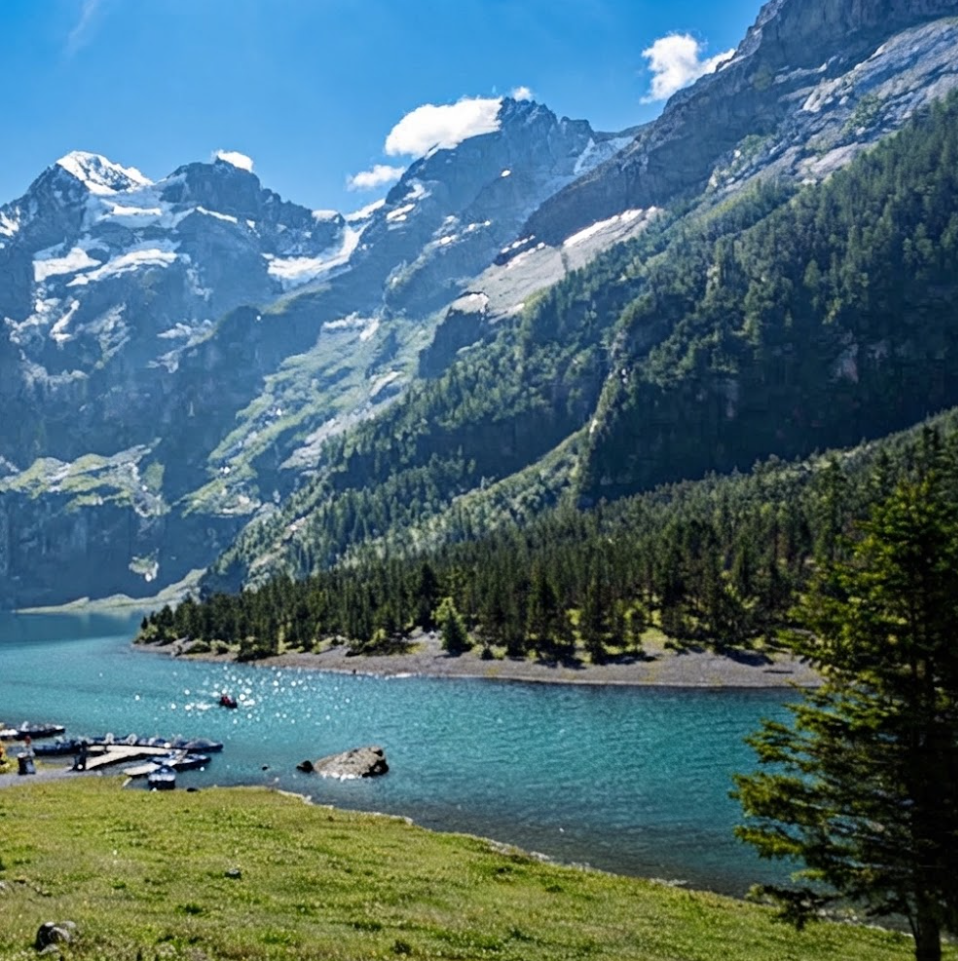
The Uphill Battle
The first three miles are relentless. The path tilts skyward, demanding lungs and legs alike. Yet with each ascent, the reward grows clearer. Morning sun spills over Birre Mountain, gilding ridges in molten gold. Shadows stretch long across the valley, and the rhythm of boots against gravel becomes a meditation.
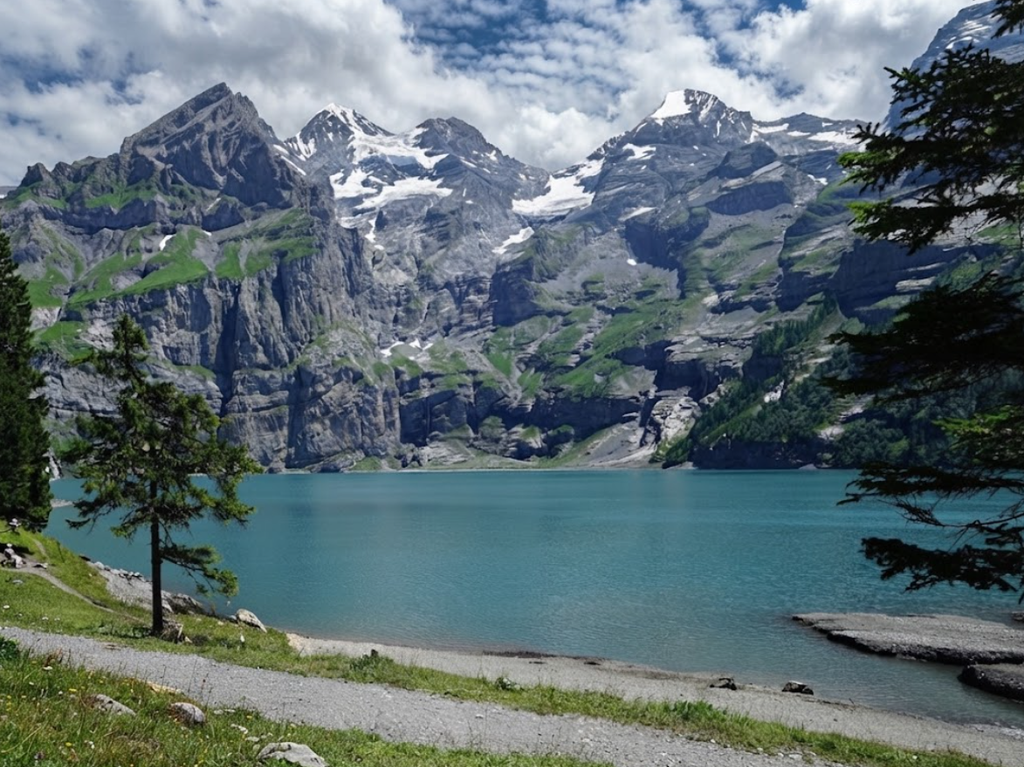
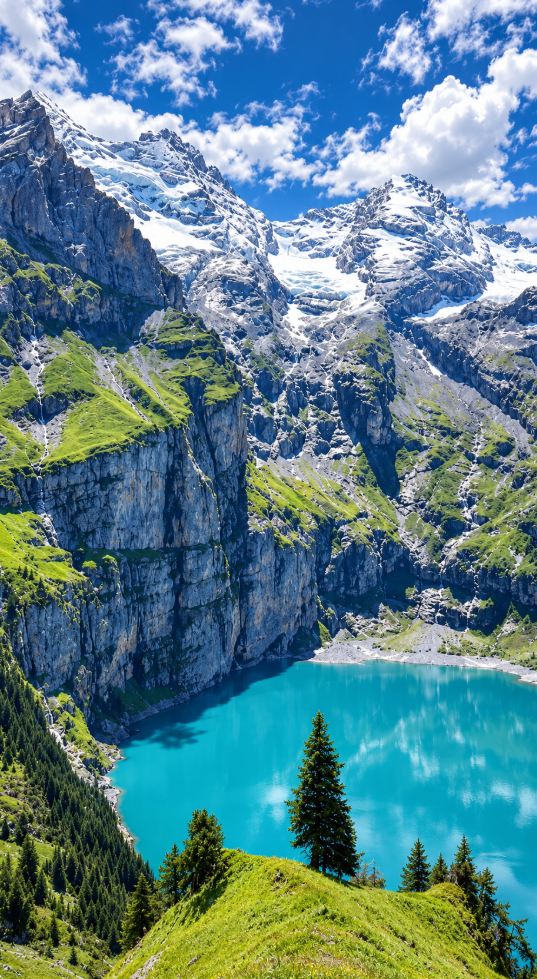
At the three‑mile mark, the lake reveals itself — turquoise, crystalline, impossibly vast. Beneath the towering cliffs of the Blüemlisalp massif, Oeschinensee lies like a jewel set in stone. The climb dissolves into awe.
Nostalgia on the Ridge
Surprisingly, the first emotion is not astonishment but nostalgia. Crossing a ridge, the landscape feels familiar, as though carried in memory long before being seen. The turquoise water, the cirque of peaks, the shifting hues of blue and gray — they stir something deeper than sight. Hiking here is not just discovery; it is remembrance, a return to beauty that feels eternal.
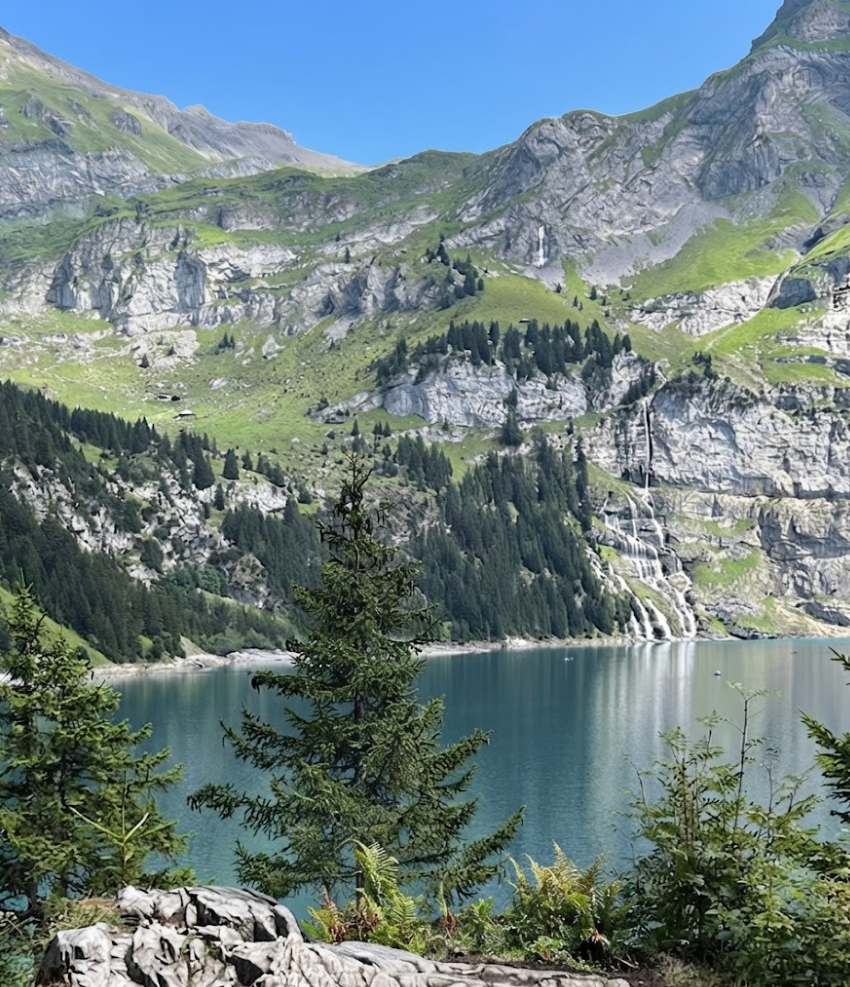
The Rock Face Warning
The campground host had spoken of a cable strung across a rock face, a traverse suspended hundreds of meters above the lake. At the time, it sounded like a challenge worth embracing. Now, standing at the highest point of the trail, the warning echoes louder. The ledge is visible — a horizontal crack etched into stone, daring hikers to cross.
Berghaus Unterbärgli: Drinks and Cowbells
Before the ledge, respite arrives in the form of the Berghaus Unterbärgli. A hut perched at 6,500 feet, its patio spills into alpine air. Umbrellas dot the terrace, and cold drinks flows from taps. Hiking in Switzerland is luxurious in ways the rugged Rockies never imagined.
The true companions here are cows — a dozen or more, grazing freely, their bells ringing with each bite. The sound is not noise but music, a mountain choir filling the air with rhythm. Sitting with drinks in hand, legs stretched, and cowbells chiming, the surreal becomes ordinary.
Encounters with Alpine Ibex
Pressing on, the trail narrows. Suddenly, horns flash in the corner of vision — three Alpine ibex charging across a grassy landing. Larger than deer, more agile than goats, they move with astonishing grace. Cameras barely capture their speed before they vanish. Moments later, they reappear above, scaling ridges with ease.
Watching them, it becomes clear: the lake and its amphitheater belong first to them. Humans are visitors, humbled by creatures that make the impossible look effortless.
Traversing the Rock Face
The ledge arrives. Steel cable glints against stone, bolted into the cliff. Fingers wrap around cold iron, knuckles whitening. The void yawns below — a fall that would last six seconds, long enough to know its end.“Don’t slip. Don’t look down.” The catchphrase repeats with each step.
Fear sharpens into focus, and the crossing becomes a dance with gravity. When the ledge ends, relief floods in. The trail continues, but the memory of that traverse lingers, etched into bone and breath.
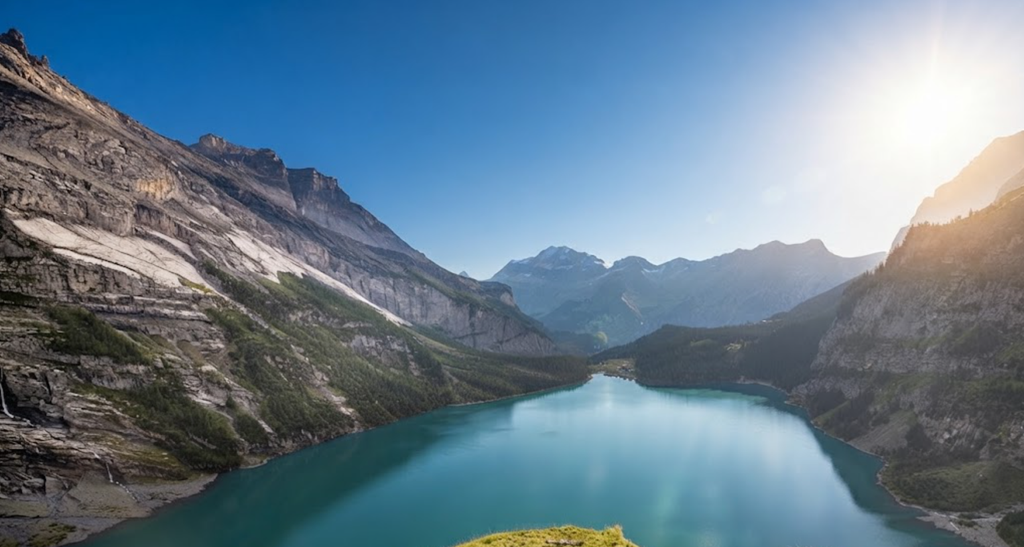
Descent to the Lake
From here, the path softens. Downhill stretches lead toward the water, each bend revealing new shades of turquoise and green. Waterfalls thread silver ribbons into the basin, fed by glaciers clinging to peaks: Doldenhorn, Fründehorn, Oeschinenhorn, and Blüemlisalphorn.The amphitheater of mountains feels alive, glaciers melting into rivers, rivers feeding the lake, the cycle of water echoing eternity.
The Tradition of Swimming
At last, the shore. Boots unlaced, clothes shed, swim trunks donned. The plunge into icy alpine water shocks the body into clarity. Muscles ache, lungs gasp, but exhilaration blooms. Swimming in Oeschinen Lake is not indulgence but ritual — a purification into wild beauty.The water is crystalline, reflecting sky and glacier. Emerging from its depths, fatigue dissolves. The hike is complete, but the experience is only beginning.
Golden Hour and Purple Flowers
Evening descends. Golden hour spills across the valley, painting peaks in amber light. Along the riverbanks, purple flowers bloom — overlooked on the ascent, now glowing like lanterns in fading sun. Their presence is a reminder: beauty lies not only in grandeur but in detail, in the small miracles missed when eyes are fixed on summits.
Return to Camp
Back at Camping Rendezvous, the day closes with smoke, curls into alpine air, mingling with the scent of pine and earth. The body is tired, the spirit full. The hike is not just a journey around a lake but a pilgrimage into awe.
Oeschinen Lake Through the Seasons
This is not a place to visit once. Oeschinen Lake transforms with each season. In spring, waterfalls roar with snowmelt, and the lake glows with fresh turquoise. In summer, trails bustle with hikers, cowbells echo across meadows, and the amphitheater feels alive. In autumn, colors deepen, glaciers glisten, and the lake becomes a mirror of fading light. Each return is a revelation, each season a new chapter in the same story.
Practical Pathways to Oeschinen Lake
Reaching Oeschinensee is simple yet unforgettable. From Brig, trains glide through the Lötschberg tunnel in under an hour. From Bern, direct routes carry travelers in just over seventy minutes. Cars ride rails across passes, a novelty of Swiss engineering. From Kandersteg, trails rise in 90 minutes, or gondolas lift hikers swiftly to the lake. Whether by foot or cable car, the journey is part of the experience — a prelude to the amphitheater awaiting above.
The Amphitheater of Peaks
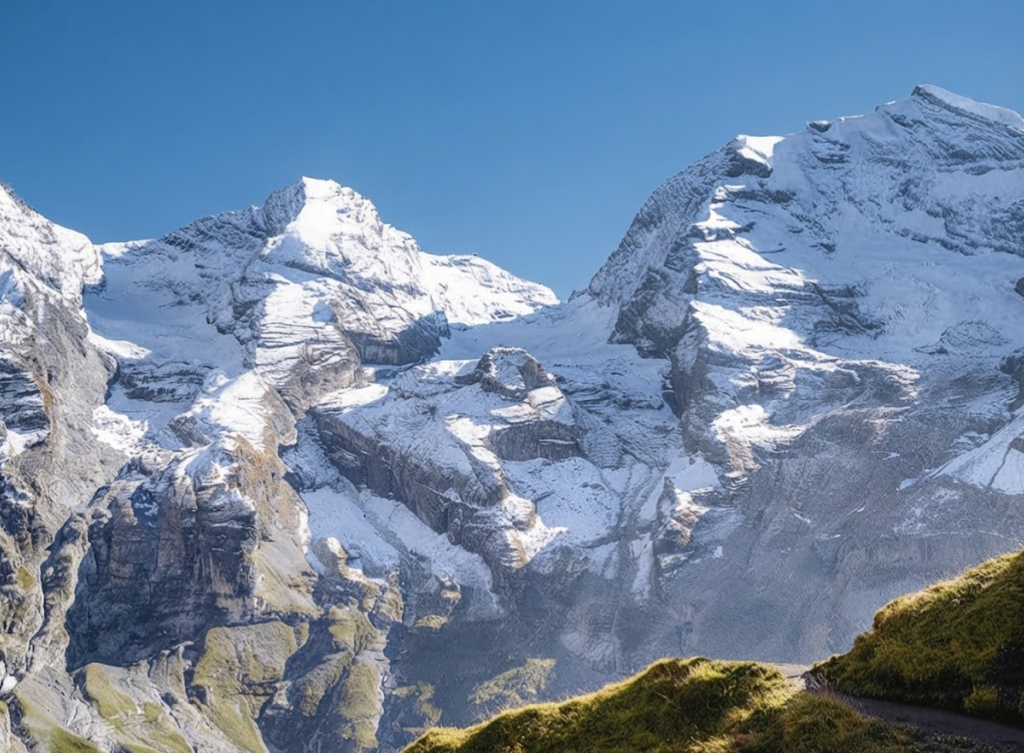
What makes Oeschinen Lake extraordinary is its setting. Peaks rise above 3,000 meters, glaciers drape their shoulders, waterfalls tumble into crystalline waters. The amphitheater opens toward Kandersteg, a stage where nature performs endlessly.The lake is not static. Its colors shift with weather and season, from turquoise to emerald, from mirror to mist. To stand here is to witness change, to feel the pulse of a landscape alive.
Reflections on Awe
Hiking Oeschinen Lake is not just exercise or scenery. It is an encounter with awe — the kind that humbles, that reminds us of scale and fragility. Glaciers melt, flowers bloom, ibex run, cowbells ring. Each detail is fleeting, yet together they form a memory that endures.The hike is long, the climb steep, the ledge daunting. Yet the reward is not only the view but the feeling: that in this amphitheater of stone and water, we are small, and that smallness is sacred.
A Perfect Ending
As night falls, stars scatter across alpine sky. The lake lies quiet, reflecting constellations. The hike ends, but the journey lingers. Oeschinen Lake is not just a destination; it is a reminder of beauty that transcends time. To hike here is to carry its memory forever — turquoise waters, towering peaks, cowbells, ibex, flowers, fear, exhilaration, and the plunge into icy clarity. It is God’s perfect design, etched into the heart of Switzerland’s mountains.