
Faroe Islands > Things to do in Faroe Islands > Lake Sørvágsvatn
Introduction
The Faroe Islands, a remote archipelago in the North Atlantic between Iceland and Scotland, are defined by their rugged cliffs, restless seas, and landscapes that seem untouched by time. Among these islands lies one of the most extraordinary natural illusions in Europe: Lake Sørvágsvatn, also known as Leitisvatn.
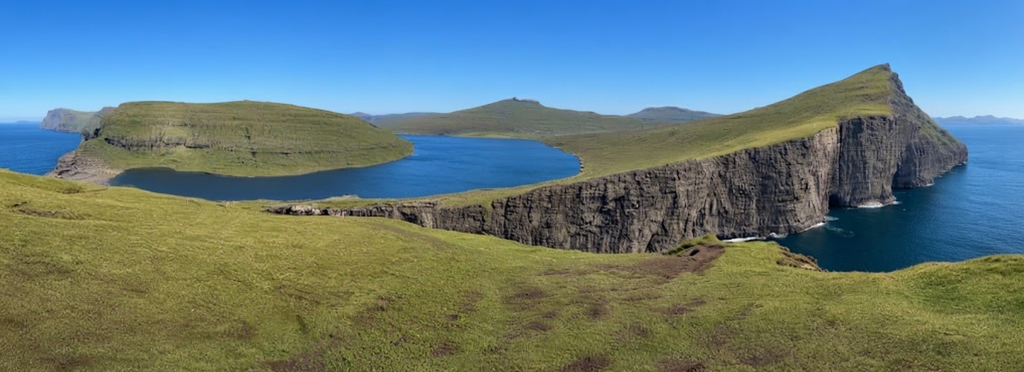
At 3.5 square kilometres, it is the largest lake in the Faroes, but its fame rests not on size alone. From the cliffs of Trælanípa, the lake appears to float above the ocean, suspended like a mirror in the sky. This optical trick has earned it the nickname “the lake above the ocean,” and it is now one of the most photographed and visited sites in the islands.
Location and Setting
Sørvágsvatn lies on Vágar Island, one of the eighteen islands that make up the Faroese chain. Vágar is the gateway to the archipelago, home to the main airport where all flights land. This makes the lake unusually accessible compared to other Faroese landmarks.
From Tórshavn, the capital, the drive takes about 50 minutes through the subsea tunnel that links Streymoy to Vágar. Once on the island, the lake is only a 5‑minute drive from the airport, with the trailhead located near the village of Miðvágur.
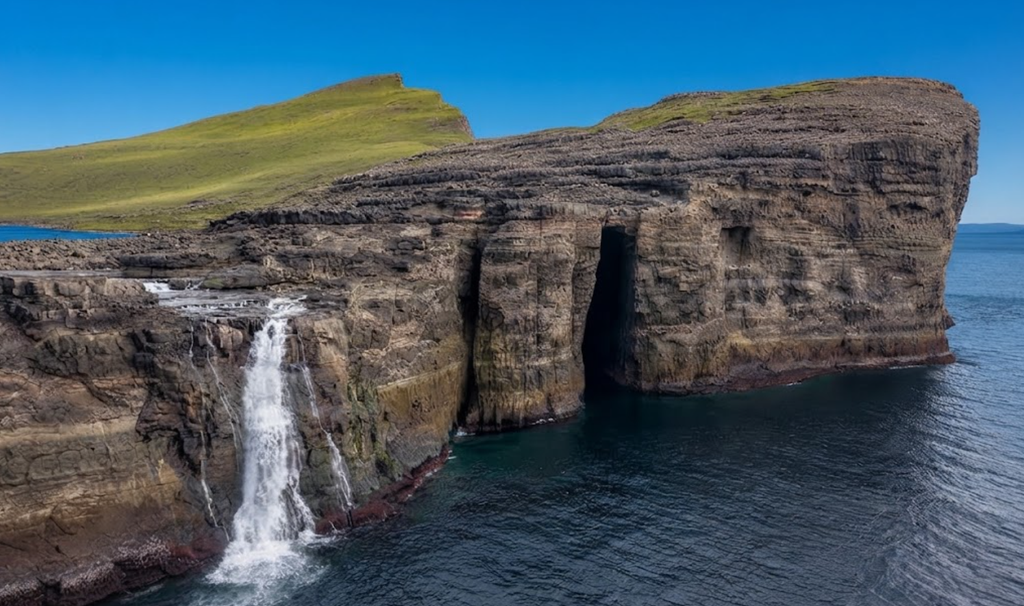
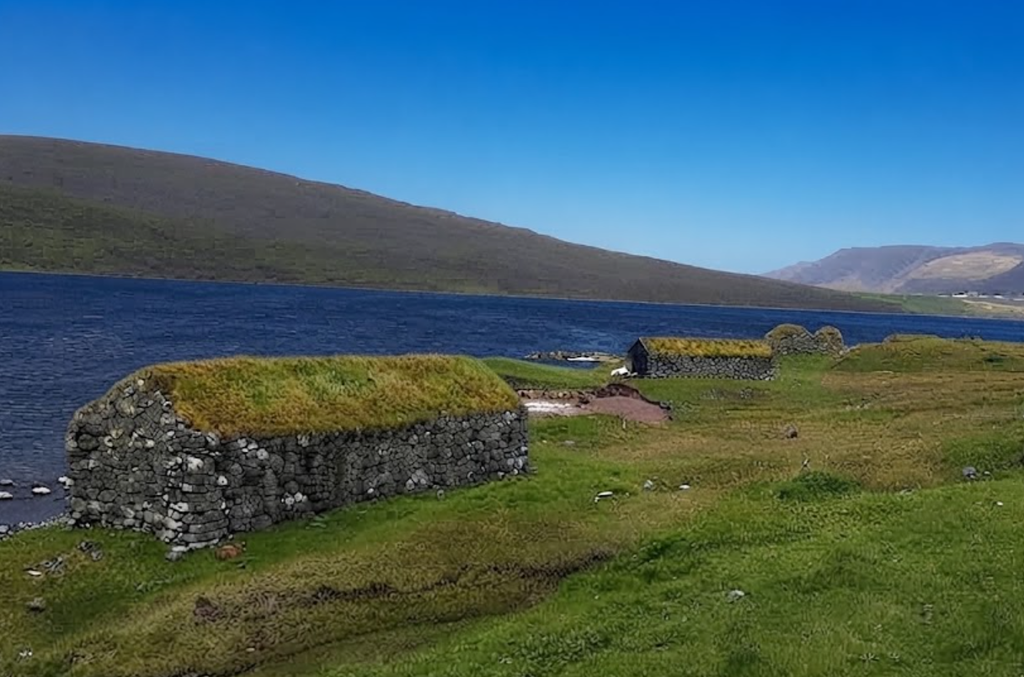
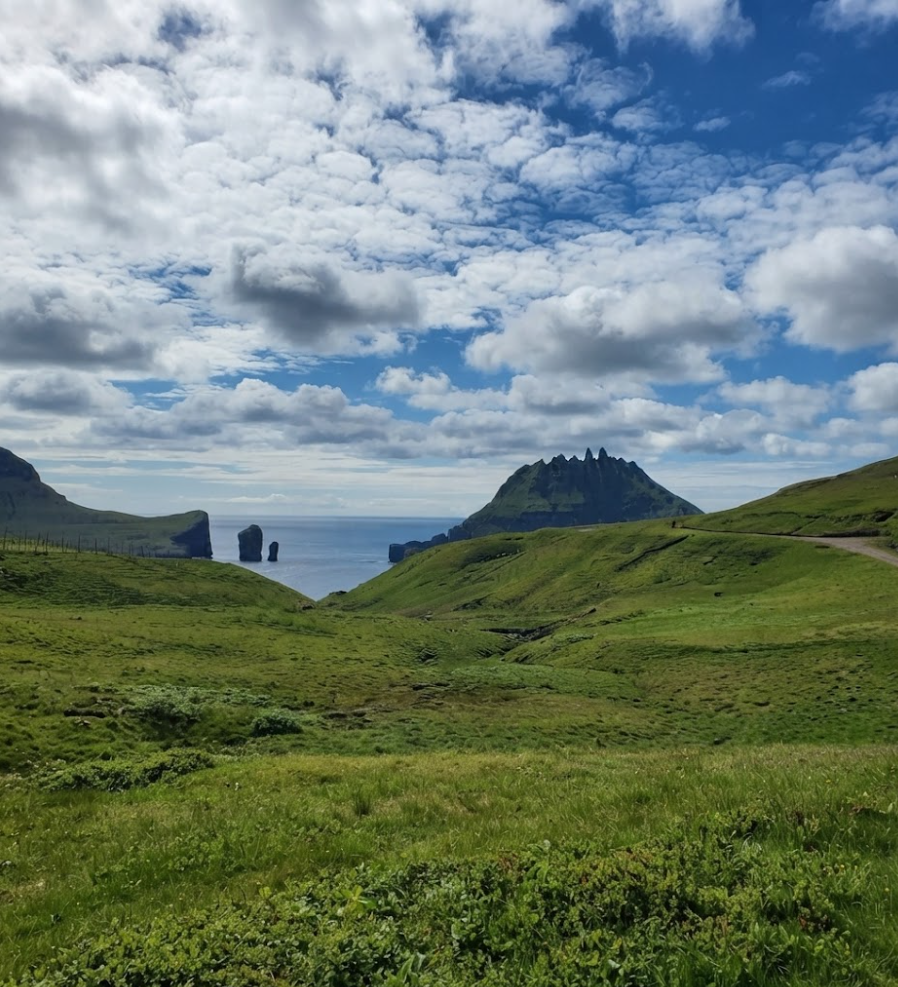
The landscape surrounding the lake is quintessential Faroese: rolling green hills, sheep grazing on open pastures, and cliffs that plunge directly into the Atlantic. The lake itself sits calmly inland, but its waters eventually flow out through Bøsdalafossur waterfall, which drops nearly thirty metres into the ocean. This dramatic outlet reinforces the illusion that the lake is perched high above the sea, a natural infinity pool spilling into the Atlantic.
The Optical Illusion
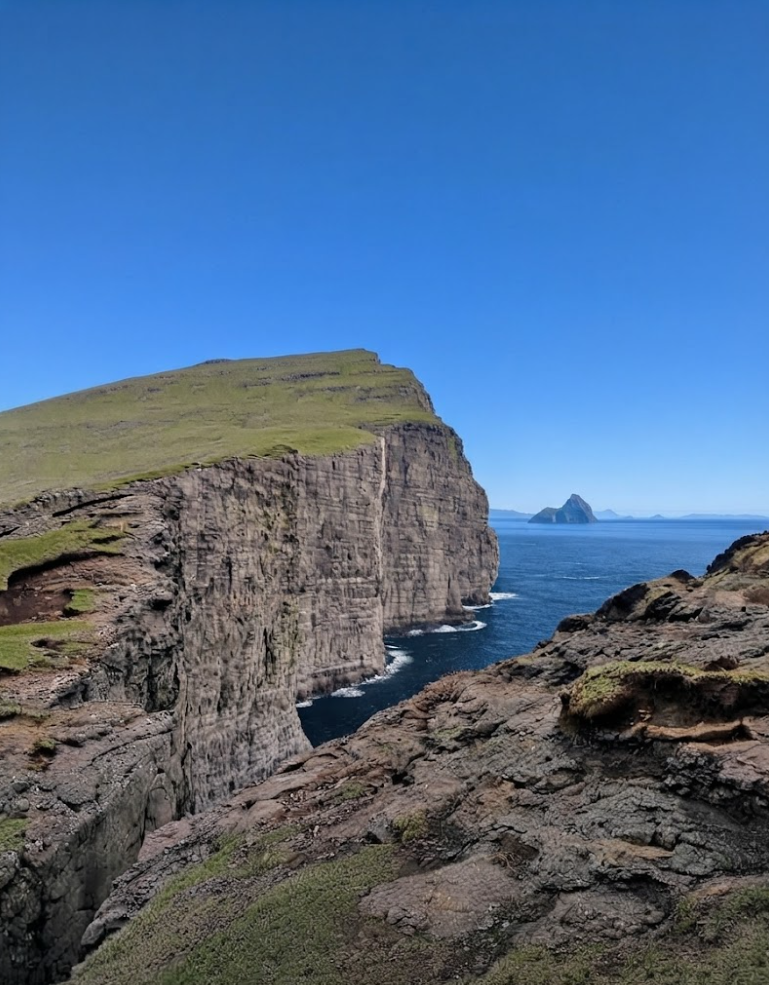
The illusion of Sørvágsvatn is entirely a matter of perspective. From most angles, the lake looks like any other body of water nestled in a valley. But when viewed from Trælanípa cliff, the alignment of lake, cliff, and ocean creates a visual trick: the lake appears to hover hundreds of metres above the sea. In reality, the difference in elevation is modest, but the sheer drop of the cliff exaggerates the effect.
This phenomenon places Sørvágsvatn alongside other natural illusions such as Yosemite’s Firefall, where sunlight makes Horsetail Fall glow like molten lava, or Bolivia’s Salar de Uyuni, where salt flats reflect the sky so perfectly that horizon and ground dissolve. In the Faroes, the illusion is not about light or reflection but about sightlines and angles. It is a reminder that nature often plays with human perception, offering landscapes that defy expectation.
The Trail to Trælanípa
The hike to the famous viewpoint begins at a small car park near Miðvágur. A modest iron gate marks the start of the trail, and visitors pay a fee of 200 DKK per person at the booth. The path is well maintained, though muddy in places, and stretches for 7.2 kilometres round trip. Most walkers complete it in 2.5 to 3 hours, though many linger longer at the viewpoint.
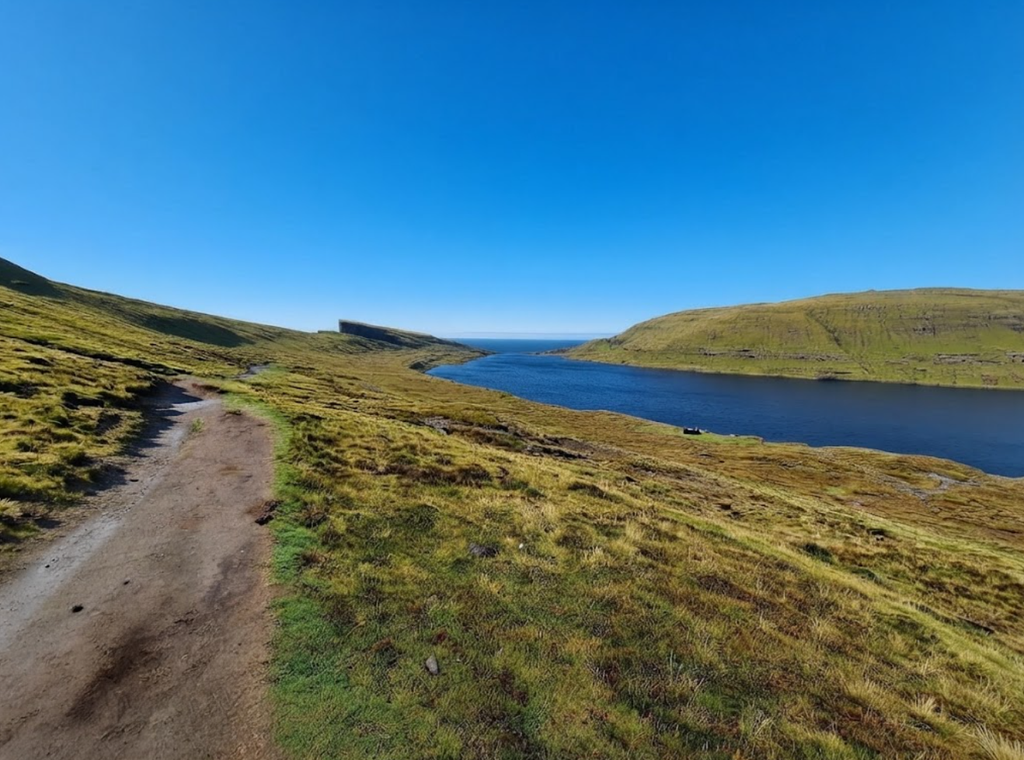
The trail first crosses farmland, then descends into scrubland dotted with small waterfalls. To the left, mountains rise gently into the clouds; to the right, the deep blue expanse of Sørvágsvatn stretches across the valley. The walk is quiet, almost eerily so, broken only by the sound of water and the occasional call of seabirds.
After about an hour, the path forks. One direction leads to Trælanípa, the other to Bøsdalafossur waterfall. The climb to Trælanípa is short but steep, requiring care near the cliff edge. There are no protective barriers, and the drop is sheer. From the top, the illusion reveals itself in full: the lake seemingly suspended above the ocean, cliffs plunging into the waves, and the Atlantic stretching endlessly beyond.
Legends of Trælanípa
Trælanípa is not only a viewpoint but also a site of legend. Its name translates to “Slave Cliff,” recalling a grim tale from Viking times. According to local lore, Vikings pushed slaves off this cliff into the sea, a brutal act that gave the rock its name.
Whether the story is true or myth, it adds a layer of historical resonance to the site. Standing on the cliff today, with the wind whipping across the face and the ocean roaring below, it is easy to imagine how such legends could take root in a landscape so stark and unforgiving.
Bøsdalafossur Waterfall
Continuing along the trail leads to Bøsdalafossur, where the lake empties directly into the Atlantic. The waterfall is not especially tall, but its setting is dramatic. On stormy days, waves crash against the cliffs, and spray blows back into the lake, creating a spectacle of water meeting water. The juxtaposition of calm freshwater and turbulent saltwater is striking, reinforcing the sense that Sørvágsvatn is perched precariously above the ocean.
Nearby stands Geituskoradrangur, a sea stack that rises from the waves like a sentinel. Together, the waterfall and sea stack frame the lake’s outlet, offering one of the most photogenic scenes in the Faroes.
Safety and Weather
The hike to Sørvágsvatn is generally safe, with a well-marked path and minimal elevation gain. However, the cliffs demand caution. There are no railings, and winds can be fierce. The Faroese saying, “If you don’t like the weather, wait 5 minutes,” is particularly apt here. Conditions can shift rapidly from sunshine to fog, from calm to gale. Visitors should dress in layers, wear sturdy boots, and avoid standing too close to edges.
Guided tours are available and can provide additional safety, especially for those unfamiliar with cliffside hiking. Yet most visitors walk independently, relying on common sense and respect for the landscape.
Best Time to Visit
The most popular time to hike Sørvágsvatn is summer, between July and August, when weather is relatively stable and daylight stretches late into the evening. Long days allow for leisurely hikes and even attempts to catch sunset from Trælanípa, though clouds often obscure the view.
Winter offers a different experience: dramatic skies, snow‑dusted cliffs, and a sense of isolation. However, daylight is limited to 2 to 3.9 hours, and conditions can be harsh. For most travelers, summer provides the best balance of accessibility and spectacle.
Practical Details
Visitors should plan for at least three hours to complete the hike, allowing time to enjoy the viewpoint. Essentials include water, sturdy hiking boots, and a camera. The fee of 200 DKK supports trail maintenance, and facilities at the trailhead include restrooms and parking.
The trail is suitable for most fitness levels, including children and older walkers. The only challenging section is the final climb to Trælanípa, which requires caution but not technical skill.

Atmosphere and Experience
Walking to Sørvágsvatn is as much about atmosphere as destination. The path winds through quiet farmland, past small waterfalls, and along the lake’s edge. The silence is profound, broken only by natural sounds. The illusion at Trælanípa is the climax, but the journey itself is immersive, a chance to feel enveloped by the Faroese outdoors.
At the viewpoint, the scene is unforgettable: the lake stretching inland, the Atlantic crashing below, cliffs rising around, and seabirds wheeling overhead. It is a moment where perception falters, where the landscape seems to defy logic.
Comparisons and Context
Sørvágsvatn belongs to a category of natural wonders that challenge human perception. Like Yosemite’s Firefall or Bolivia’s Salar de Uyuni, it is a place where angles, light, or reflection create illusions. Yet unlike those sites, Sørvágsvatn’s trick is not seasonal or weather‑dependent. It is permanent, a feature of geography rather than climate.
This makes it a reliable highlight for travellers to the Faroes, a site that delivers its spectacle regardless of conditions. It is also emblematic of the islands themselves: dramatic, mysterious, and shaped by the meeting of land and sea.
Upshot
Lake Sørvágsvatn is more than a hike or a viewpoint. It is a Faroese icon, a place where geography and perception combine to create wonder. Easy to reach yet visually astonishing, it embodies the essence of the islands: landscapes that are both beautiful and unsettling, legends that linger in the cliffs, and weather that keeps visitors humble.
For those who make the walk from Miðvágur to Trælanípa, the reward is not only the illusion of a floating lake but also the experience of the Faroes themselves—raw, unpredictable, and unforgettable.