
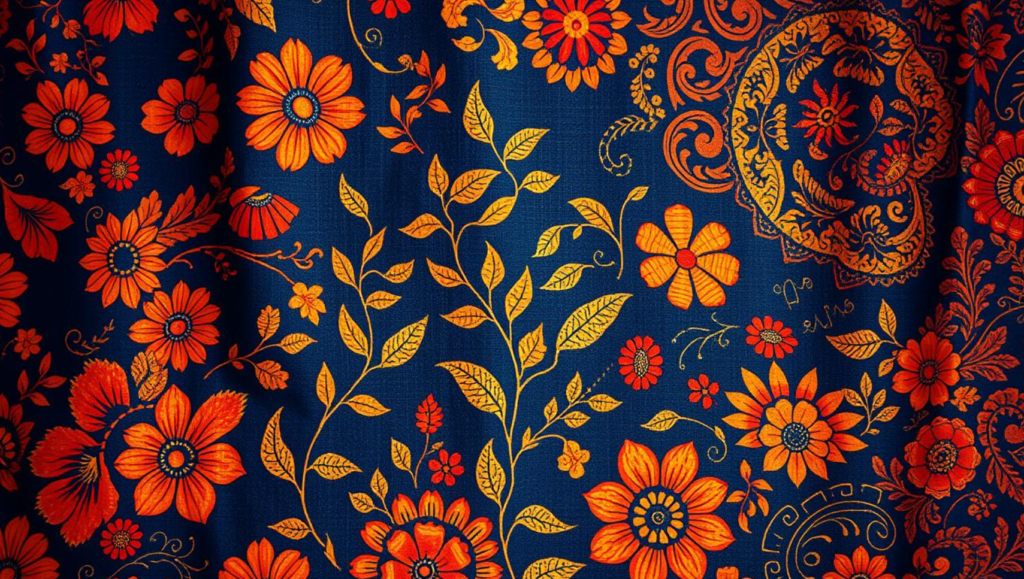
🌺 Batik in Malaysia: A Living Canvas
Salt air mingles with the scent of hot wax drifting from a batik‑maker’s shack by the sea. Outside, a dozen freshly printed cloths sway in the breeze, a riot of color against the horizon. At the doorway, a slight Malaysian artisan wipes beads of sweat — the fire, the equatorial sun, and his devotion to craft all etched into his labor of love: batik, drawn by hand.
✨ A Tradition Rooted in Southeast Asia
No one knows when batik first appeared, but in Southeast Asia it is woven into life itself. In Java, infants are swaddled in it, couples marry in it, the departed are wrapped in it. In Malaysia, influenced by Indonesian traditions, batik has evolved — tourism and fashion industries now carry it into new stylistic directions, while artisans preserve its soul.
🎨 The Art of Batik Tulis
The process begins with fabric stretched taut — cotton, silk, or linen. Designs are sketched in pencil, then traced with a canting, a stylus with a copper spout that drips hot wax in delicate streams. Sometimes a brush replaces the canting, but the principle remains: wax resists dye, preserving the design.
The cloth is dipped, dried, waxed, and dyed again until the desired effect emerges. Traditionally, natural dyes from indigo, roots, bark, and seeds gave batik its hues; today, synthetic dyes often take their place. Once the wax is rinsed away in hot water, the fabric is hung to dry, sometimes adorned with embroidery or sequins — a canvas transformed into living art.
🪞 Batik Cap: Stamped Stories
Another technique, batik cap, uses copper stamps pressed into wax before dyeing. Faster, more uniform, yet no less beautiful, these stamps themselves are intricate artworks — geometric, floral, animal motifs crafted by specialized hands.
🌍 Batik Today in Malaysia
Factories and semi‑industrial workshops now drive much of Malaysia’s batik industry, with some steps outsourced to home‑based painters. Contemporary designers weave batik into modest tunics, headscarves, and global fashion lines, while family‑run artisan enterprises keep the handmade tradition alive in select regions.
🛍️ The Challenge of Authenticity
Malaysia’s textile scene is vibrant but complex. Screen‑printed fabrics often mimic handmade batik, and tourist‑market souvenirs — cushion covers, placemats, cover‑ups — may not be traditional. Factory tours are easy to arrange, but discerning true quality in shops requires a keen eye.
🌟 A Living Heritage
Batik in Malaysia is more than fabric. It is a dialogue between wax and dye, tradition and innovation, artisan and world. Each piece carries the rhythm of Southeast Asia’s history, the shimmer of its future, and the quiet devotion of those who still craft it by hand.
Buy Ticket here >> Malaysia Batik Experience