
Origins in Motion
The Paris–Brest circular form of the pastry mirrors the wheel of the cyclist, a symbol of speed, stamina, and the romance of travel. To eat a Paris–Brest is to taste a piece of French cultural history, where sport and gastronomy intersect in a single golden ring.
Its enduring popularity lies in this symbolism: a wheel of choux, filled with praline cream, dusted with sugar, and served as both celebration and indulgence.
The Heart of Choux
At the center of the Paris–Brest lies choux pastry, a dough unlike any other. Unlike puff pastry or shortcrust, choux begins on the stovetop. Butter, water, milk, salt, and flour are cooked together until they form a smooth paste. Eggs are then beaten in one at a time, transforming the mixture into a glossy batter.
This process is both art and science: too few eggs and the dough will be stiff, too many and it will collapse. When piped into its wheel shape and baked, the dough swells into a hollow shell, crisp on the outside and tender within. The magic of choux lies in its ability to puff without yeast, relying instead on steam to create its airy structure.
Baking to Perfection
The oven is where the Paris–Brest takes shape. The choux ring is piped onto parchment, brushed with egg wash, and sprinkled with almonds. At first, it bakes at a high temperature to encourage rapid rise, then the heat is lowered to allow the shell to dry and firm.
The baker must resist the temptation to open the oven door too soon; the pastry needs time to set its structure. A small slit cut into the side near the end of baking helps release steam, ensuring the interior is dry rather than soggy. The result is a shell that is light yet strong, ready to cradle the cream within.
The Soul of Praline
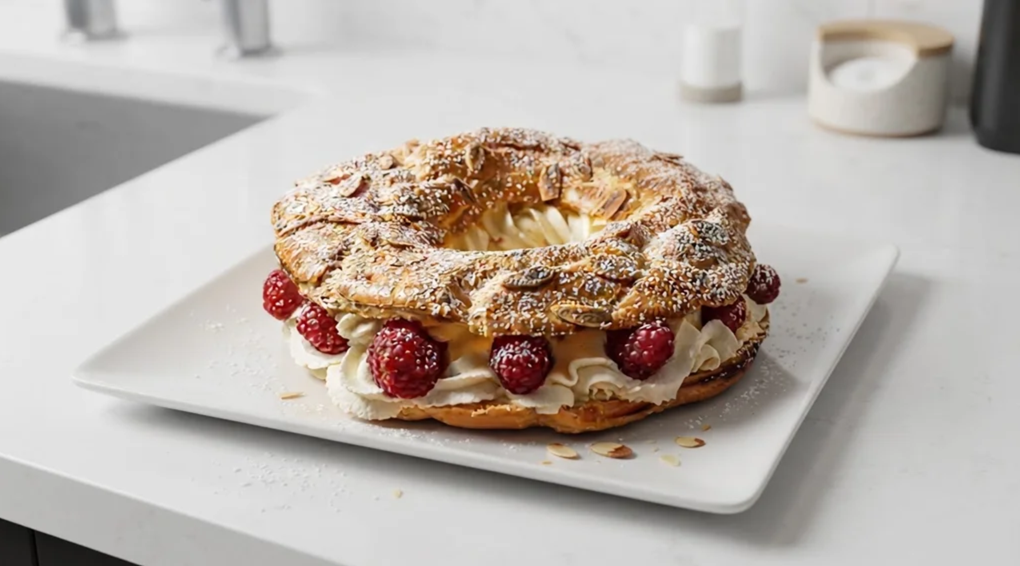
If choux is the body of the Paris–Brest, praline cream is its soul. Traditionally, almonds and hazelnuts are caramelized with sugar, then ground into a paste. This praline is folded into pastry cream, enriched with butter, and whipped into crème mousseline.
The transformation is extraordinary: pastry cream alone is smooth and custardy, but with butter and praline it becomes velvety, nutty, and decadent. The flavor is deep and aromatic, with notes of caramel and roasted nuts. It is this filling that defines the Paris–Brest, giving it its characteristic richness and allure.
A Balanced Structure
The beauty of the Paris–Brest lies in its balance. Three elements work in harmony: The choux shell, light yet crisp, offering resistance to the bite. The praline cream, smooth and rich, carrying the nutty perfume of caramelized almonds and hazelnuts. The slivered almonds, baked into the crust, adding crunch and visual appeal.
Together, they create a dessert that is both airy and indulgent, simple in appearance yet complex in flavor.
Modern Variations
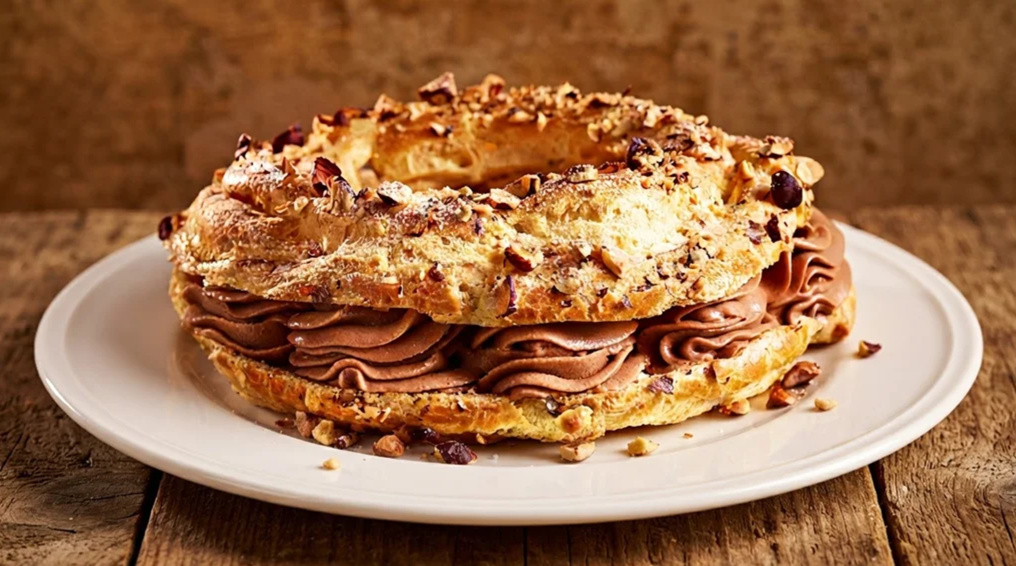
Though tradition insists on the circular form, modern pastry chefs have experimented with reinterpretations. Some offer individual servings, small rings that can be enjoyed without slicing. Others shape the pastry into éclairs or rectangles, prioritizing practicality over symbolism.
Flavors have expanded too: chocolate, coffee, pistachio, and exotic fruits now find their way into the cream. Yet purists argue that only the circular form, filled with praline cream, deserves the name Paris–Brest. The wheel must remain intact, the nutty aroma dominant, the balance preserved.
Technique and Craft
Every step in making a Paris–Brest requires precision. Caramelizing the nuts with sugar infuses the praline with depth, while a touch of baking soda eases grinding and intensifies flavor. A careful blend of milk and water in the choux dough ensures a shell that is both crisp and well-browned.
Egg wash brushed over the ring helps almonds adhere, baking into a crust that is as beautiful as it is delicious. Cooling the pastry in the oven prevents collapse, while slicing horizontally allows the cream to be piped generously inside. These details, though small, are what separate a perfect Paris–Brest from a mediocre one.
Serving Traditions
The Paris–Brest is best served chilled, sliced into generous portions. It pairs beautifully with coffee, whose bitterness offsets the sweetness of praline, which enhances its richness. For added indulgence, a drizzle of ganache or salted caramel can be added, or a scoop of vanilla ice cream served alongside.
Whether presented at a family table or in a patisserie window, it is a showstopper, its wheel-like form inviting admiration before the first bite.
Storing and Enjoying
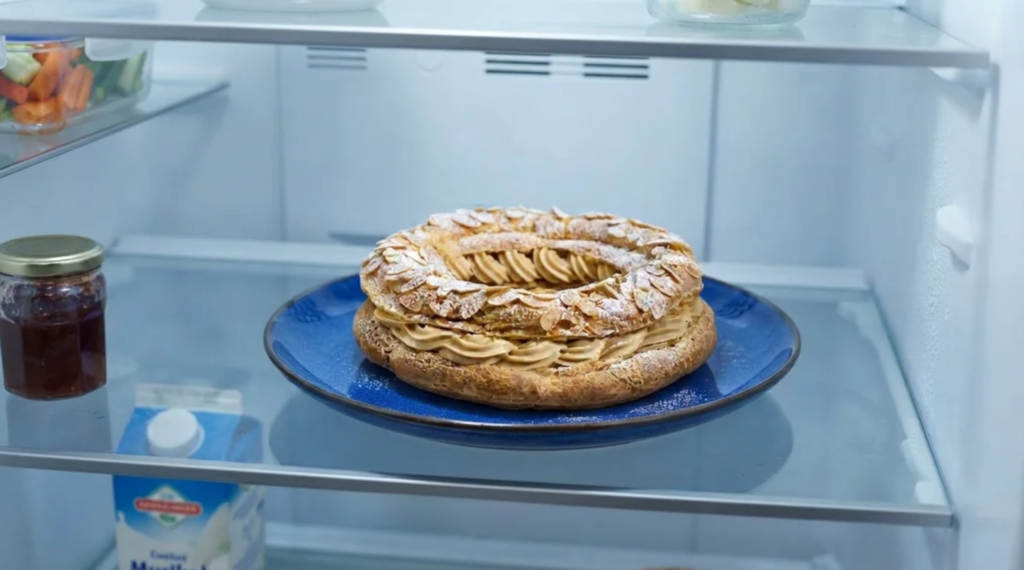
Though best enjoyed fresh, the Paris–Brest can be stored in the refrigerator for a day or two. Over time, the cream will soften the shell, creating a different but still delightful texture. For longer storage, the choux pastry and filling can be frozen separately, then assembled when needed.
Wrapped and sealed, they keep for up to a month. Yet the true pleasure lies in immediacy: the crisp shell, the velvety cream, the crunch of almonds—all best experienced soon after assembly.
A Culinary Symbol
The Paris–Brest is more than a dessert; it is a symbol of French pastry’s ability to combine tradition with artistry. Its wheel shape ties it to history, its praline cream anchors it in flavor, and its variations show its adaptability. It is at once simple and complex, rustic and refined.
To make it is to engage in a ritual of precision and patience; to eat it is to savor a harmony of textures and tastes. In every slice lies the story of a race, a culture, and a craft.