
The Highway Approach
Driving north from Vancouver, the Sea-to-Sky Highway curves through coastal forest and granite cliffs. The road itself feels like a ribbon laid across the mountains, winding past bays and peaks, each turn revealing another sweep of Howe Sound.
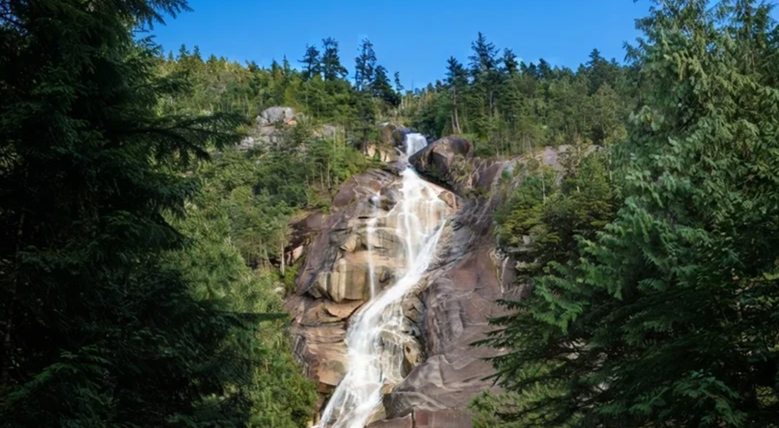
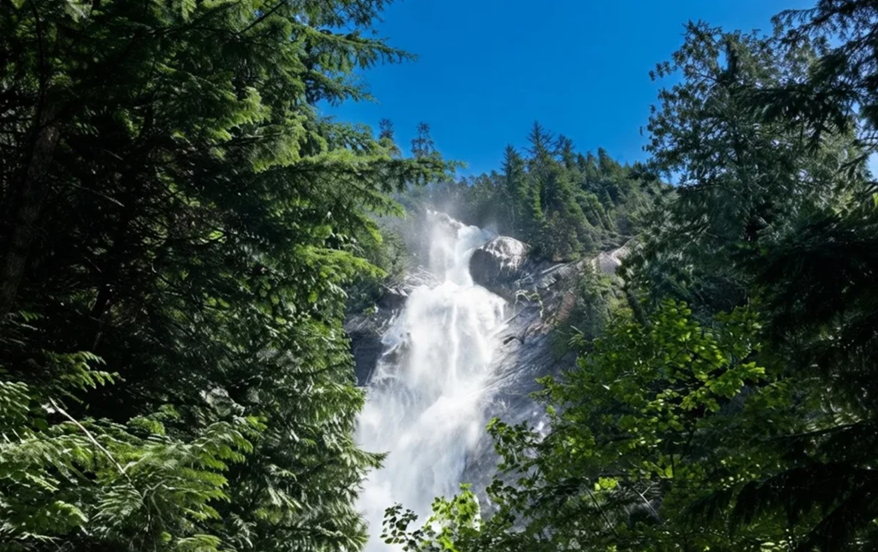
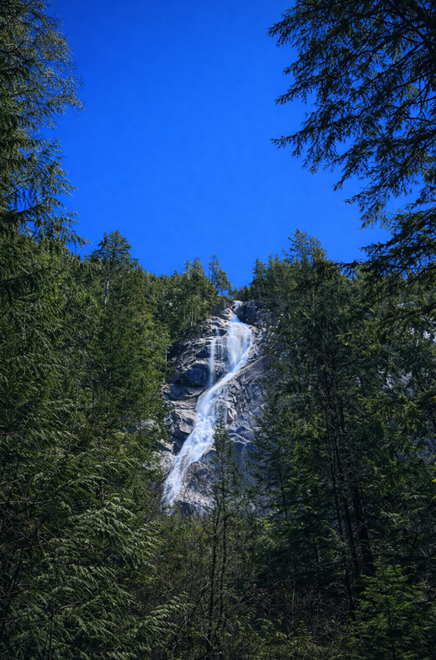
Two kilometers south of Squamish, the forest parts and the sound of rushing water rises above the hum of traffic. Shannon Falls appears suddenly, a silver torrent plunging 335 metres down sheer granite. Even from the highway, it is impossible to miss — a spectacle that commands attention, a natural landmark that has drawn travelers for centuries.
A Park With Many Lives
The land beneath the falls has carried many identities. In the late 1800s, William Shannon purchased it, shaping bricks from the clay at the base of the cliffs. His brickworks operated until 1900, when Britannia Mine acquired the property. Later, during the Depression, the site became a workers’ camp, and in the early years of highway construction, it housed crews who carved the road into the mountainside.
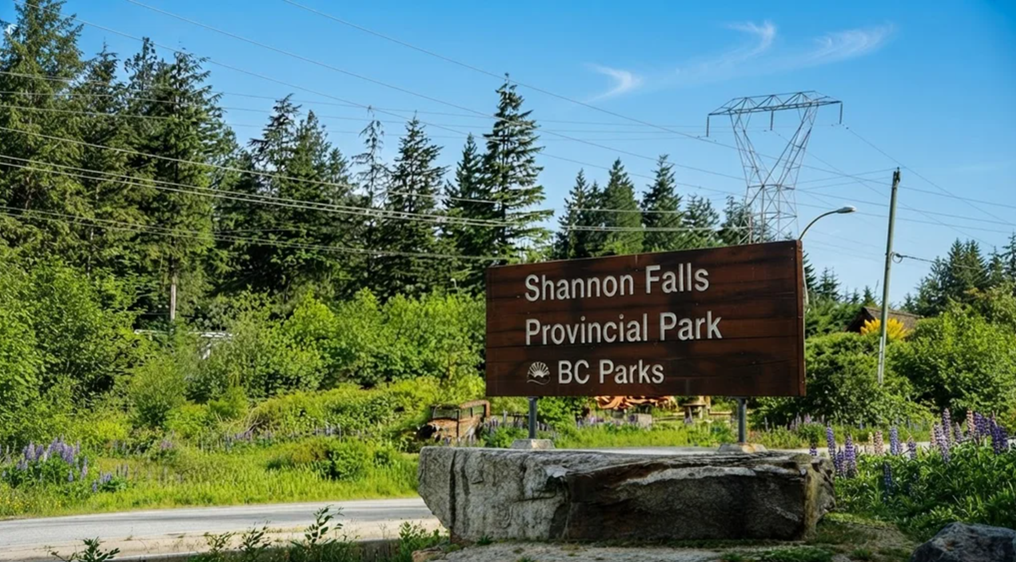
By the mid-20th century, the Carling-O’Keefe brewery used the fresh water for its beer, and a forestry show park displayed logging equipment that now rests along Loggers Lane. Only in 1984 did the land become Shannon Falls Provincial Park, a sanctuary of granite cliffs, old-growth forest, and cascading water.
The Sound of Water
From the park entrance, a boardwalk leads into the forest. The trail is short — less than twenty minutes — but every step deepens the anticipation. The creek runs beside you, its waters born of alpine glaciers: Sky Pilot, Stadium, Habrich. Meltwater crashes down the valley to form Shannon Creek, tumbling over boulders before plunging into the falls.
In spring, when snowmelt swells the flow, mist drifts across the forest, dampening hair and clothing. In summer, the falls soften, but the cliffs remain streaked with water and light. The sound is constant, a roar that drowns conversation, a reminder of nature’s power.
Echoes of Culture
For the Squamish people, this place holds stories older than the highway. Kwek’uet’wxm tells of a great snake dwelling in the granite cliffs, a legend woven into the landscape. Along the Spirit Loop Trail, plaques share these histories, grounding visitors in the cultural weight of the land.
To walk here is not only to see a waterfall but to step into a living narrative, where stone and water carry memory.
The Picnic Grounds
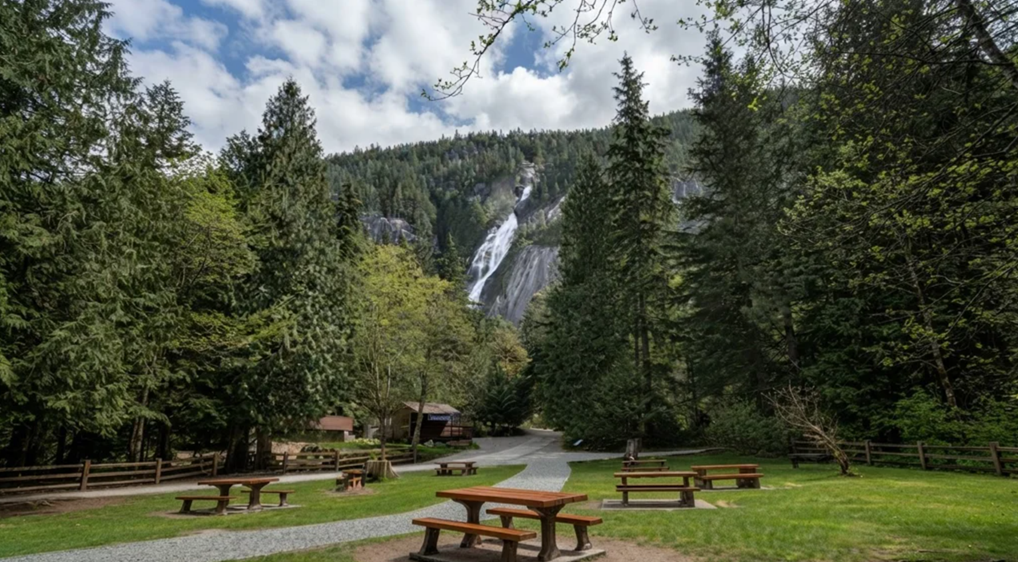
Most visitors linger at the picnic area near the entrance. Families spread blankets on the grass, children chase each other across the open space, and the sound of the falls fills the background. Picnic tables dot the grounds, shaded by Douglas firs and cedars.
A concession stand offers food for those who did not bring their own, and an information centre provides maps and souvenirs. Washrooms and water fountains make the park comfortable for a few hours’ stay. For many, Shannon Falls is a stopover on the drive to Whistler, a place to stretch legs, eat lunch, and marvel at the cascade before continuing north.
Trails That Connect
Though the main trail to the falls is short, paths branch out into the forest. Some connect to Stawamus Chief Provincial Park, where granite cliffs rise like the profile of an Indigenous Chief’s head. Others lead toward the Sea-to-Sky Gondola, completed in 2014, which carries visitors to a summit lodge with sweeping views of Howe Sound.
From there, trails fan out: Wonderland Loop for children, Panorama Loop for families, Skyline Ridge for distance hikers, Sky Pilot Trail for mountaineers. Each path is a different invitation, a different way to inhabit the mountains.
The Gondola Experience
The gondola changed everything. Before 2014, hikers laboured both up and down the Sea to Summit Trail, a 7.8 km grind compared to North Vancouver’s Grouse Grind. Now, they climb only one way, riding down in ten minutes of sweeping views. At the Summit Lodge, a dozen trails tailored to different abilities.
Dogs are allowed only on the descent, a rule that keeps numbers manageable. For many, the gondola is not just transportation but part of the experience — a way to see the landscape from above, to float past cliffs and forest, to watch Howe Sound spread out below.
The Falls Themselves
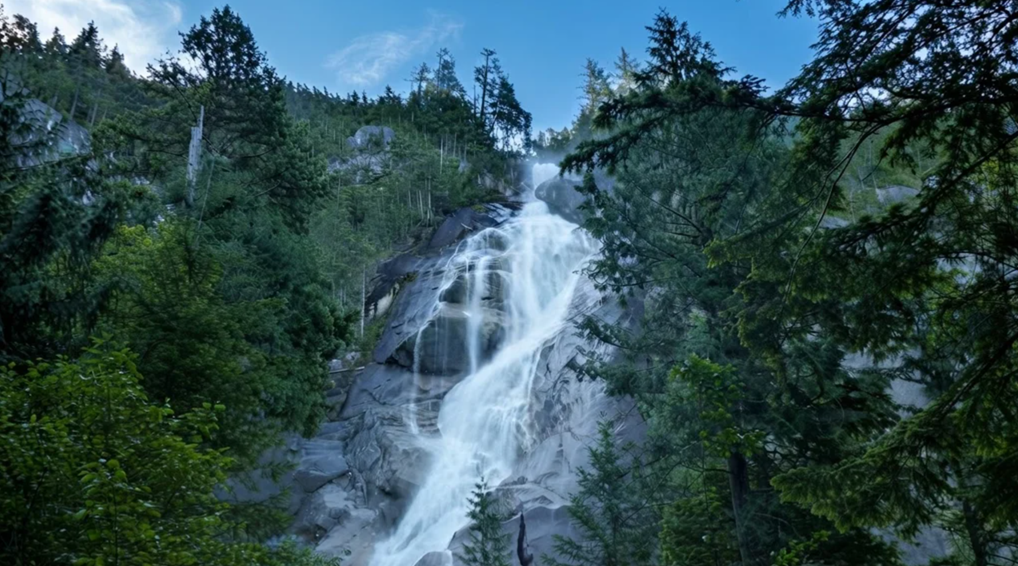
At the viewing platforms, anticipation peaks. Water cascades in white torrents, crashing into boulders, filling the air with a roar that vibrates through the ground. Sit on the bench at the upper lookout and you feel the spray on your face, the vibration of water against stone.
The cliffs rise sheer above, streaked with moisture, while the creek tumbles away into the forest. Howe Sound glimmers in the distance, a reminder that this spectacle is part of a larger coastal drama.
A Place Between Worlds
Shannon Falls is both a roadside stop and a wilderness gateway. Families linger at picnic tables, climbers tackle rock slabs south of the falls, seasoned hikers push toward The Chief or Whistler. The park is small — just 87 hectares — but it is layered with stories: geological, cultural, industrial, recreational. To walk here is to step into all of them at once.
The Creek and the Boulders
At the base of the falls, countless boulders lie scattered, deposited by centuries of water and stone. In summer, when the creek runs low, visitors clamber across them, finding cool spots to sit and watch the water. But in spring, when snowmelt swells the flow, the creek becomes a raging torrent, dangerous to approach.
The contrast is striking: calm waters one season, violent floods the next. The landscape shifts with the weather, reminding visitors that nature is never static.
The Chief Nearby
Adjacent to Shannon Falls lies Stawamus Chief Provincial Park, home to one of the largest granite monoliths in the world. Trails connect the two parks, allowing hikers to move from waterfall to mountain. The Chief rises like a sentinel above Squamish, its cliffs popular with climbers and its summit offering panoramic views.
Together, the falls and the Chief form a natural partnership: water and stone, cascade and cliff, each enhancing the other’s grandeur.
Seasonal Shifts
In spring, Shannon Falls is at its most powerful, fed by snowmelt from the alpine massif. Mist sprays the forest, dampening leaves and clothing. In summer, the flow lessens, revealing more of the granite beneath. Autumn brings rain, swelling the creek again, while winter freezes parts of the cascade into icy sculptures.
Each season offers a different experience, a different way to see the falls.
Practical Notes
Parking at the park can be difficult, especially in summer, and thefts have been reported from unattended cars. Visitors are advised not to leave valuables inside. The trail itself is easy, suitable for families and those using wheels, though stairs lead to the upper lookout.
A rain jacket and sturdy shoes are recommended, as the area often sees medium to high chances of rain. The suspension bridge nearby offers views of the mountains, adding another dimension to the visit.
A Stop Along the Journey
For many, Shannon Falls is a stop along the drive to Whistler, a place to pause between city and resort. The highway itself is part of the experience, winding past bays and peaks, each turn revealing another view. Shannon Falls adds drama to the journey, a reminder of the power of water and stone. Whether you stay for twenty minutes or several hours, the falls leave an impression, a memory carried north or south along the road.
The Story of Water
The waters of Shannon Falls originate from Mount Habrich and Mount Sky Pilot, fed by glaciers and alpine snowfields. They crash down Sky Pilot Valley, forming Shannon Creek, before plunging over the cliffs. The journey of water is long, from mountain to valley to sound, and the falls are one moment in that journey.
To stand at the viewing platform is to witness that moment, to see water in motion, to feel its power.
A Place of Contrast
Shannon Falls is both accessible and wild. The trail is short, the picnic area comfortable, the concession convenient. Yet the falls themselves are untamed, roaring down cliffs, dangerous to approach in flood. The park balances these contrasts, offering both ease and awe, both comfort and challenge.
It is a place where families picnic and climbers scramble, where legends dwell and water roars.
The Lasting Impression
As you leave the park, the sound of the falls fades, replaced by the hum of the highway. Yet the memory lingers: the sight of water plunging down granite, the feel of mist on your face, the roar that filled the air. Shannon Falls is more than a stopover; it is a landmark, a story, a spectacle. It is a reminder of nature’s power, of the layers of history that shape a place, of the way water and stone create beauty.