
A Threshold Between Worlds
To step into the Abbey Library of St. Gallen is to cross a boundary where centuries dissolve. The ornate Baroque doorway, guarded by rows of felt slippers, insists on ritual: visitors must slip them on before entering, a gesture both practical and symbolic.
The soft footwear muffles sound, protects the walnut floors patterned with stars, and prepares the mind for reverence. Within moments, the bustle of the 21st century fades, replaced by the hush of parchment, fresco, and carved wood. It is not merely a museum but a living institution, an oasis of silence and knowledge where the past breathes through every page.
Around 190,000 visitors arrive each year, far outnumbering the dwindling community of pilgrims. Tourism sustains the site, reflected in the gift shop’s offerings of fondue sets and bird seed — modern echoes of ancient hospitality.
The Scriptorium’s Legacy
Each manuscript was a labor of devotion, requiring countless hours of careful handwriting and illumination. Among the treasures is Abrogans, the oldest preserved book in the German language, a fragile yet monumental link to the linguistic roots of Europe.
Guardians of Knowledge
Figures such as Notker Balbulus, remembered for his stutter yet celebrated for his brilliance, and Ekkehart IV, tireless in his scholarship, left indelible marks on the abbey’s intellectual heritage. Their works, preserved in these halls, remind us that wisdom often emerges from perseverance rather than perfection.
The manuscripts they created and studied became part of a collection that now numbers 160,000 volumes, including more than 2,100 medieval codices.
Survival Through Turmoil
The library’s survival is itself a story of resilience. The Hartmut Tower shielded its manuscripts through fires, wars, and the upheavals of the Reformation. When the princely abbey was dissolved in 1797, the fate of the library hung in the balance. Yet careful stewardship ensured its continuity.
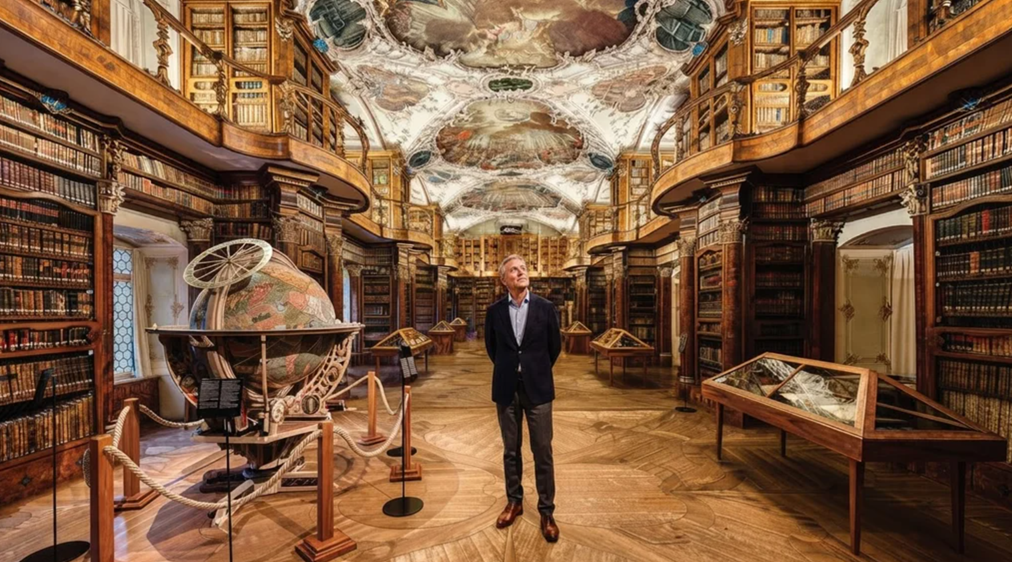
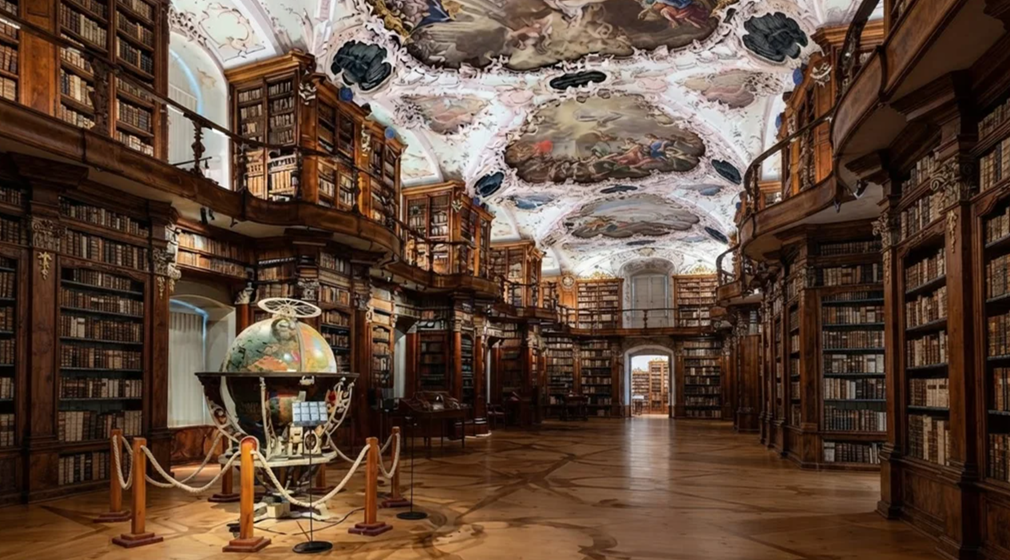
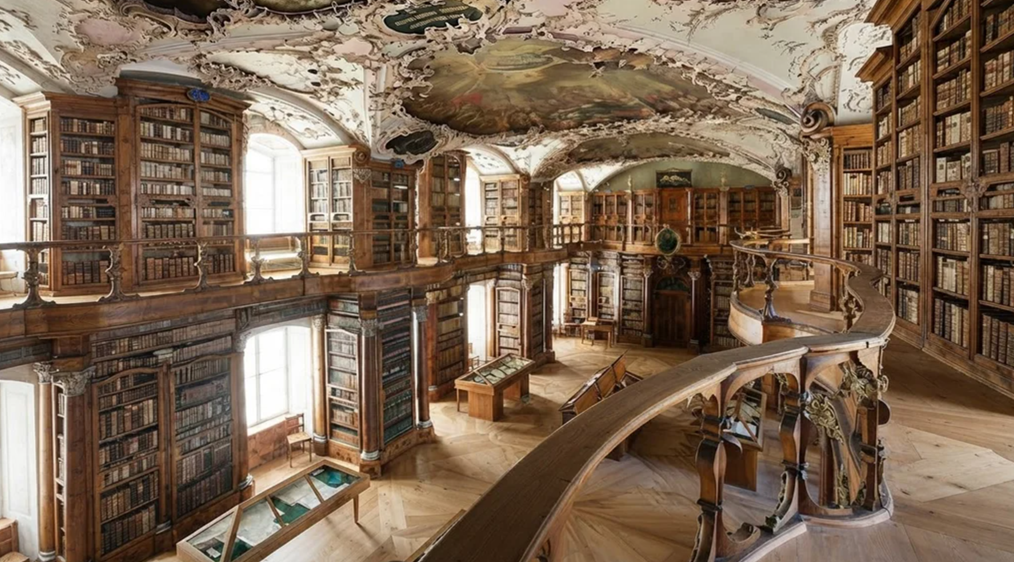
By 1767, the collection had been given a new home: the Baroque hall that still astonishes visitors today, a room where angels hover in stucco and fresco above shelves that curve like waves of carved wood.
A Baroque Jewel
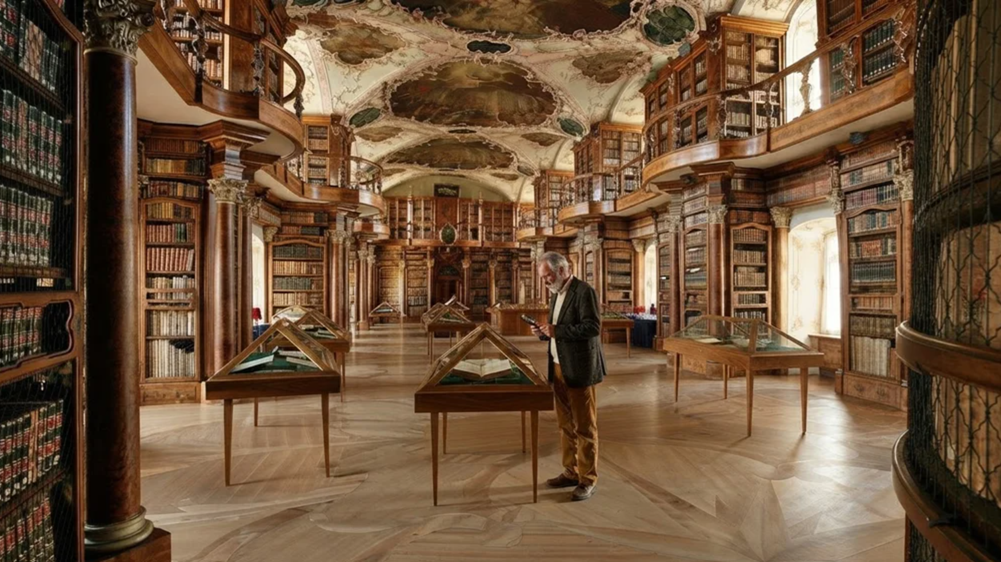
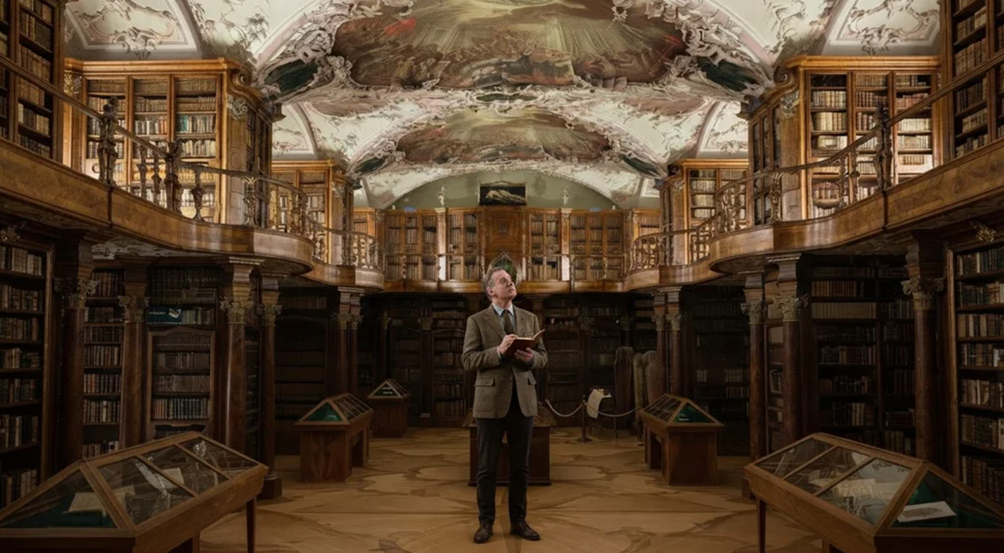
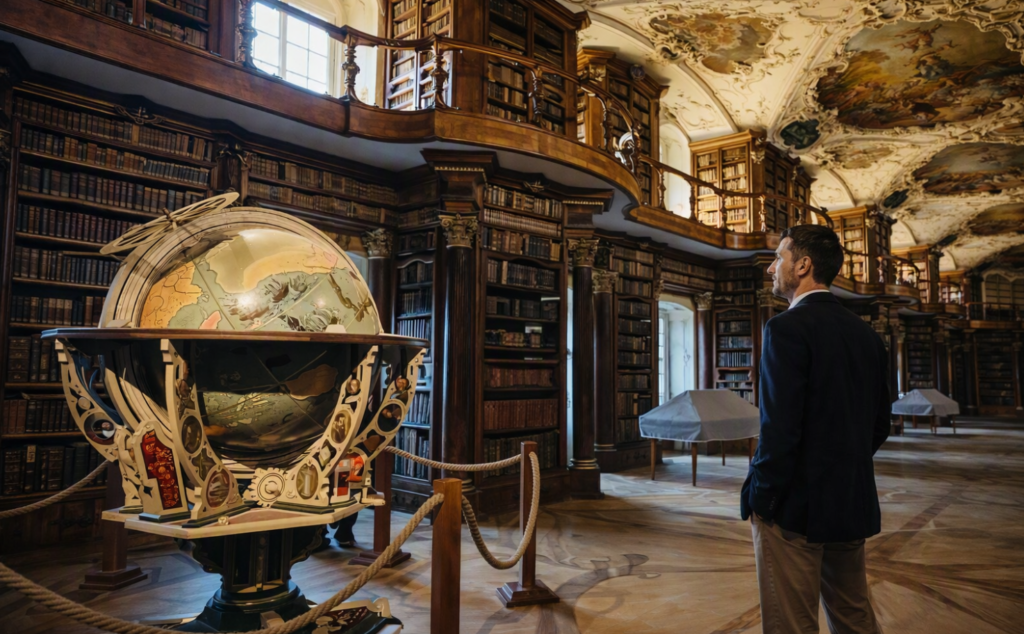
The Baroque hall is the library’s crown. Ceiling frescoes in pastel pinks and yellows depict celestial councils and cherubic figures, their heavenly light contrasting with the warm brown tones of the bookcases below.
The shelves themselves are masterpieces, their ornamentation a celebration of craftsmanship. To walk here is to feel enveloped by artistry, as if the very architecture is a hymn to knowledge.
Cabinets of Curiosities
Beyond books, the library houses cabinets of curiosities — collections of objects gathered from across the world between the 16th and 19th centuries. Fossils, shells, coins, speak of a fascination with the exotic and the rare. These objects remind us that libraries are not only about texts but about the human impulse to collect, preserve, and marvel.
The Giant Globe
One of the library’s most striking artifacts is its giant globe, dating to 1571. Over two meters tall, it depicts both the heavens and the earth in astonishing detail. Though the original was stolen in 1712 by Zurich troops, the replica — crafted by fifty people over 7,000 hours — is so precise that it feels authentic.
It stands as a symbol of the library’s ability to reclaim and preserve even what was once lost.
Irish Manuscripts and High German Texts
The library holds the largest collection of Irish manuscripts in mainland Europe, gifts left by pilgrims on their way to Rome. These texts connect St. Gallen. Equally valuable are the Old High German manuscripts, which contain the earliest examples of the language preserved in writing. Together, they form a bridge between cultures, languages, and epochs.
Traditions of Preservation
The slippers at the doorway are more than quaint tradition. They symbolize the delicate balance between accessibility and preservation. Only 100 pairs exist, limiting the number of visitors at any one time. Even tripods must wear their own protective coverings, a reminder that every detail of conservation matters.
The ritual of slipping into these felt shoes becomes part of the experience, binding each visitor to the library’s guardianship of its treasures.
Exhibitions and Displays
In the middle of the hall, wooden and glass showcases display manuscripts open to their illuminated pages. Visitors can see the artistry of medieval handwriting, the intricate designs that frame sacred texts, and the sheer diligence required to produce them.
Temporary exhibitions, such as the display of cabinets of curiosities, expand the narrative, showing how libraries and museums continue to grapple with rare and fragile objects.
A Comparison of Sanctuaries
Those who have visited Austria’s Admont Abbey Library often compare the two. Admont dazzles with light, airy and ethereal, a fortress of brightness. St. Gallen, by contrast, feels warmer, more intimate, a sanctuary of wisdom rather than spectacle.
Its beauty lies in detail, its atmosphere in hushed reverence. Together, they represent two interpretations of the Baroque spirit: one radiant, the other contemplative.
Beyond the Library: Drei Weieren
A short uphill walk from the city leads to Drei Weieren, the three ponds that overlook St. Gallen. From here, visitors can see Lake Constance and enjoy green spaces where locals swim, stroll, and relax. It is a reminder that the abbey library, though timeless, exists within a living city, a place where history and daily life intertwine.
The Awe of Encounter
To stand among books handwritten centuries ago is to feel awe. Each manuscript embodies countless hours of labor, devotion, and artistry. The library is not simply a collection of texts but a monument to human diligence. Visitors linger, imagining the monks who once bent over parchment, their quills scratching out words that would echo across centuries.
Photography and Private Access
Photographers granted private access speak of the experience as transformative. To enter in the early morning, before the doors open to the public, is to encounter the library in solitude. The curved shelves, the carved cherubs, the frescoed ceilings — all reveal themselves in silence.
The act of photographing becomes less documentation than homage, a way of capturing the ineffable beauty of the space.
A Bridge Across Centuries
The Abbey Library of St. Gallen is more than Switzerland’s oldest library, more than Europe’s intellectual treasure. It is a bridge across centuries, a place where the written word has outlasted empires, wars, and dissolutions. Its manuscripts, curiosities, and artifacts are not relics but living echoes, ready to reveal their wonders to anyone who knows how to read them.
The Sanctuary of Wisdom
Few places in the world feel as though time has truly stopped. The Abbey Library of St. Gallen is one of them. Its frescoes, manuscripts, and artifacts form a sanctuary where wisdom is preserved not as nostalgia but as living heritage. To walk here is to join a continuum of seekers — scholars, and tourists — all bound by the same awe before parchment and ink.
It is a place where the past lives on in a thousand pages, whispering stories to those willing to listen.