There are places in the world where movement itself becomes memory. Where the act of going from one point to another is not simply transit, but transformation. In Niagara Falls, Canada, that moment arrives when you step into the glass carriage of the Falls Incline Railway.
It is not a long journey. Barely a minute, sixty-two seconds to be exact. Yet in that minute, the world rearranges itself. The roar of the Horseshoe Falls grows louder, the mist rises higher, and the landscape unfurls in a way that makes you feel both small and infinite. This is not just a funicular. It is Niagara’s shortcut, its gentle descent, its invitation to linger.
A Seamless Connection
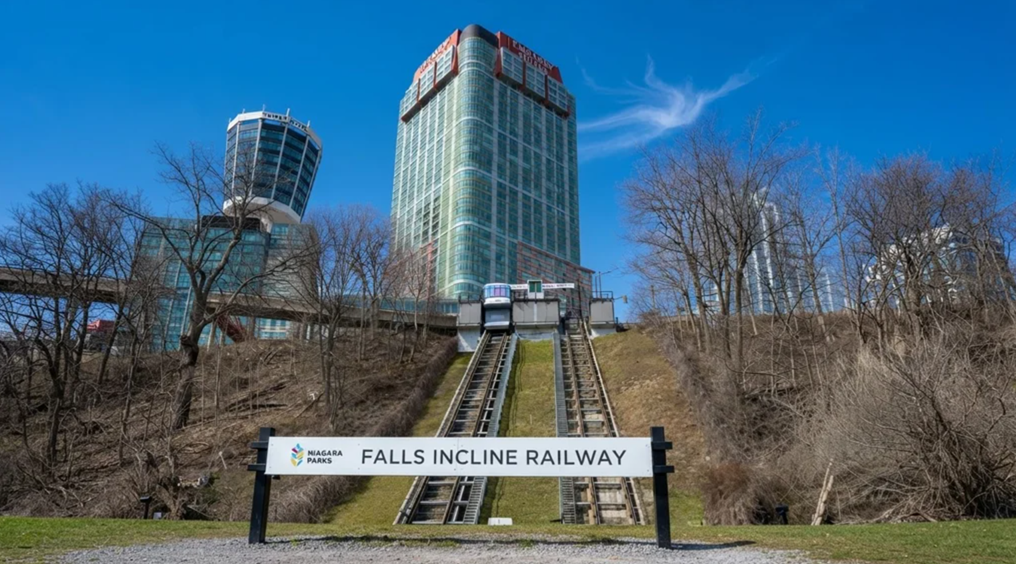
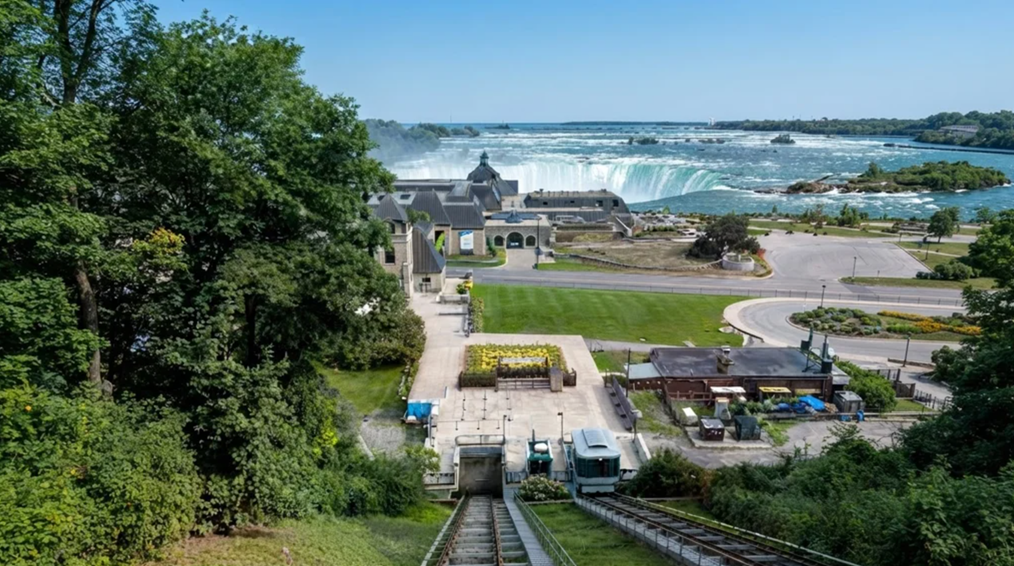
The railway is a thread stitching together two distinct worlds. Above, the Fallsview Tourist Area — a district of hotels. Below, the Table Rock Centre — the beating heart of Niagara Parks, perched at the very brink of the Horseshoe Falls. Walking between them is possible, of course.
Murray Street winds its way down from Fallsview Boulevard to the Niagara Parkway. But the walk is steep, and after a day of sightseeing, the climb can feel endless. The Incline Railway solves this problem with grace. It spares visitors the exhaustion, offering instead a smooth glide down the slope, framed by views that make you forget the practicality of the ride.
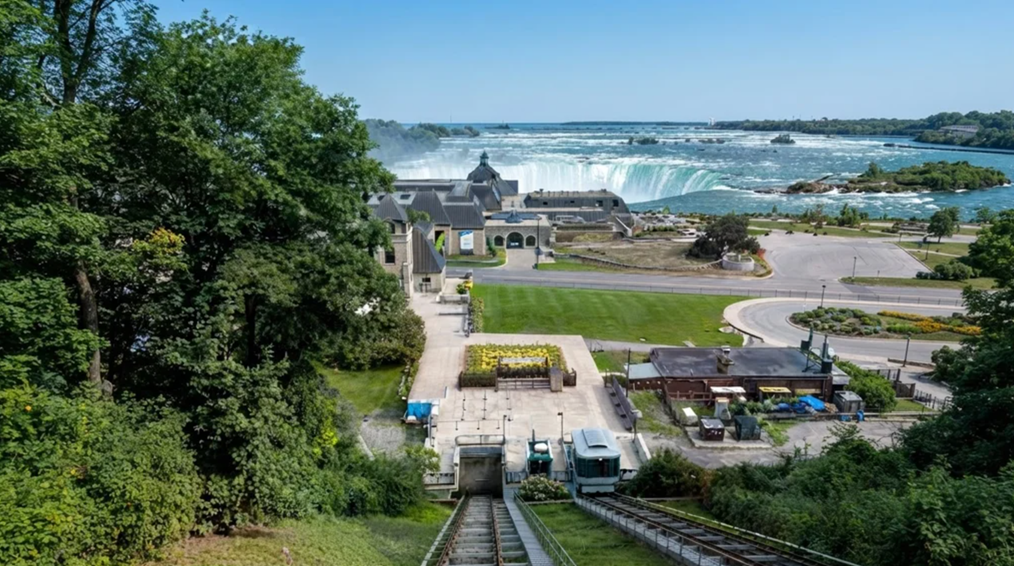
At the bottom, the “Bridge of Flowers” pedestrian crossing leads directly into Table Rock. From there, the falls are only steps away.
Views in Motion
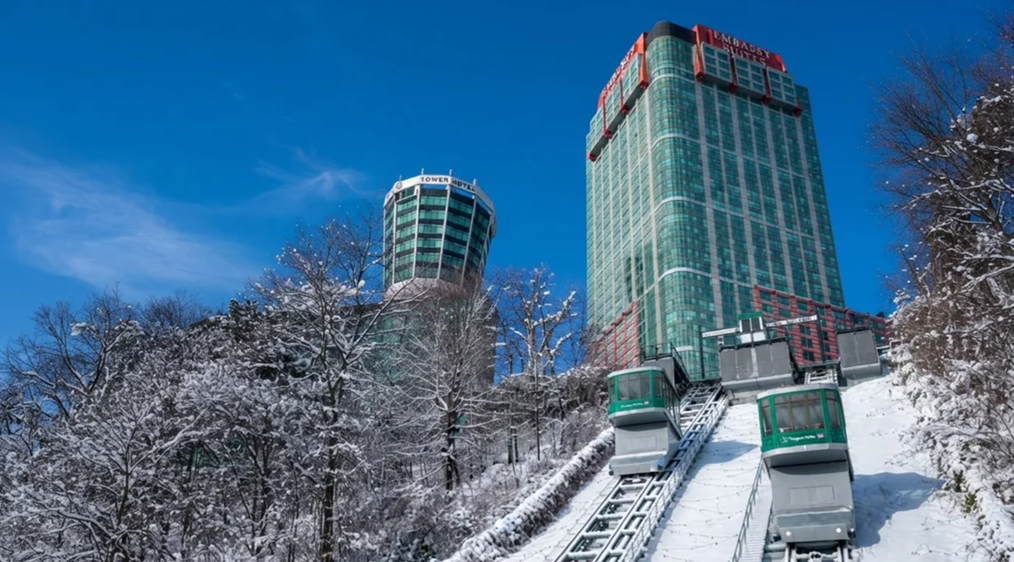
The Incline Railway does not rush. Its maximum speed is one metre per second — deliberate, unhurried. The pace is intentional, designed to let passengers absorb the panorama.As the car descends, the Horseshoe Falls appear like a living painting. The water surges, the mist billows, and the sound is a constant thunder.
To the side, Queen Victoria Park stretches green and wide, dotted with gardens and pathways. The Niagara Parkway curves gracefully, a ribbon of road that has carried generations of visitors to the falls. It is a view that changes with the seasons. In summer, the gardens bloom in riotous colour.
In autumn, the trees burn gold and crimson. Winter brings a different kind of magic — ice crystals forming on the railings, mist freezing mid-air, the falls themselves framed by snow. The railway, enclosed and climate-controlled, continues to operate, offering warmth and shelter even as the world outside turns to frost.
A Living History
Incline railways are not new to Niagara. For over 230 years, they have been part of the landscape. At one time, as many as eight operated along the Niagara River gorge — five on the Canadian side, three on the American. Most are gone now, decommissioned or dismantled, their tracks erased by time.
The Falls Incline Railway, originally known as the Horseshoe Falls Incline, was first built in 1966 by the Von Roll Company of Switzerland. Its cars were open-air, designed for summer use. They offered fresh breezes but little protection against the mist and cold. Eventually, the system was retired.
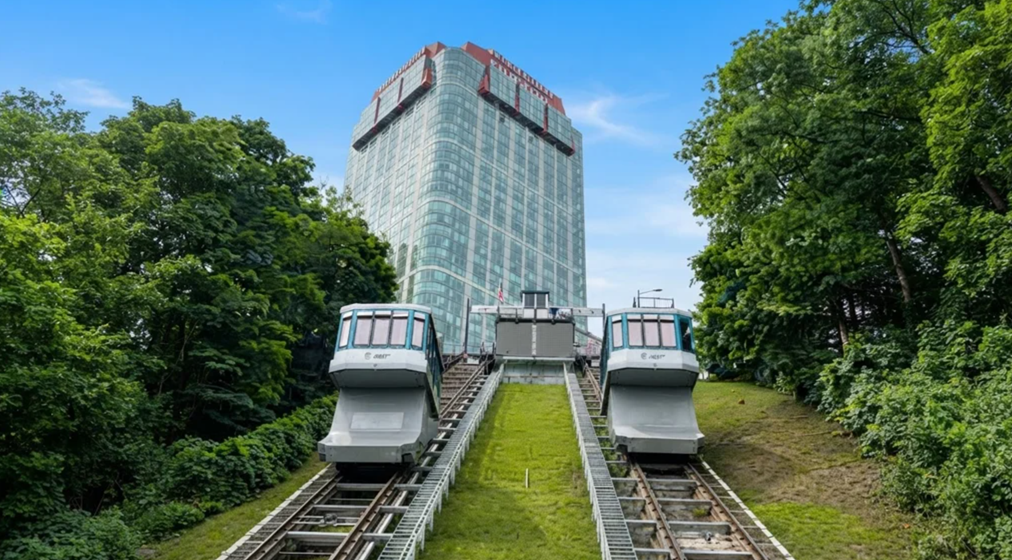
In 2013, the railway was reborn. Modern enclosed cars replaced the old, climate-controlled and accessible, designed for year-round operation. Today, it is the only incline railway still in service at Niagara Falls. A survivor, a continuation, a reminder of the past wrapped in the technology of the present.
Practical Notes
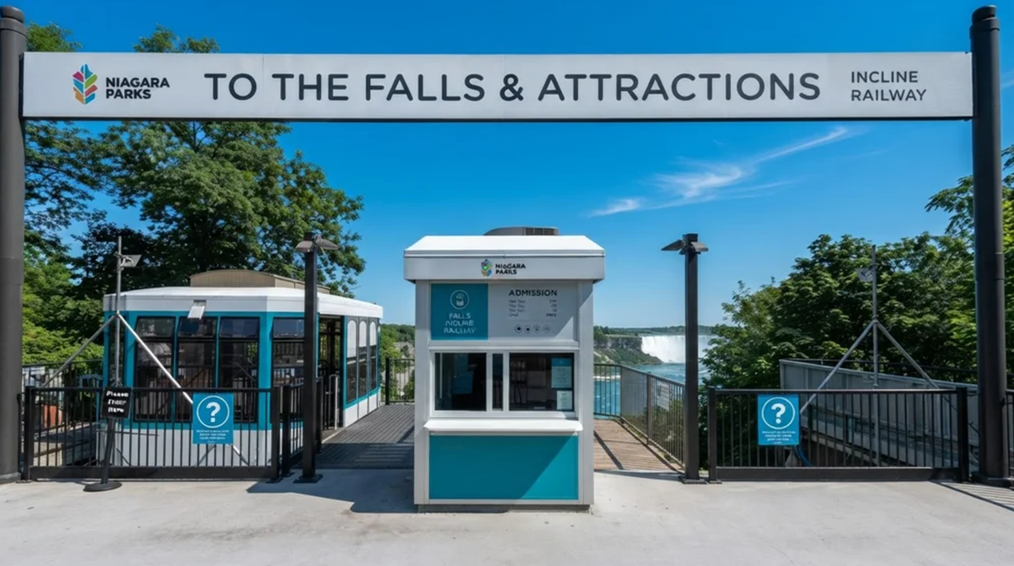
The Incline Railway is not expensive. Tickets are available at kiosks at both ends, or at Niagara Parks welcome centres. A one-way ride costs just $2.66 CAD. A round trip is $5.31. An all-day pass, allowing unlimited rides, is $6.19. Children under five ride free. The journey itself lasts barely a minute, but it saves fifteen minutes of uphill walking.
For families with children, for older visitors, for anyone weary after a day of sightseeing, it is a gift. The railway’s technical details are modest but precise:
Length: 59.8 metres
Slope: 30 degrees
Cars: 2, each with capacity for 40 passengers
Double track configuration
Track gauge: 1,850 mm
Traction: Electricity
It is a system designed not for speed, but for reliability, accessibility, and experience.
The Table Rock Connection
At the bottom station, the Incline Railway delivers passengers directly to Table Rock House. Built in 1853, this historic building has evolved into the Table Rock Centre, a hub of dining, shopping, and attractions. Here, visitors can browse gift shops, enjoy a meal overlooking the falls, or step onto the observation deck for a closer view.
The famed Journey Behind the Falls begins here, leading adventurers through tunnels carved into bedrock to observation portals directly behind the curtain of water. The railway makes this connection effortless. From hotel to attraction, from casino to cascade, it is a seamless link.
The Rhythm of the Day
To ride the Incline Railway is to experience Niagara in rhythm. Morning rides are quiet, the mist catching the first light of day. Midday brings crowds, families and tour groups filling the cars, laughter mingling with the roar of the falls. Evening rides are softer, the lights of Fallsview glowing above, the falls illuminated below in shifting colours.
The railway operates year-round, with hours stretching from early morning to late at night. In peak season, it runs until midnight, carrying visitors back to their hotels after fireworks over the falls.
Beyond Convenience
It would be easy to dismiss the Incline Railway as merely practical. A way to save time, to avoid a steep climb. But to do so would miss its essence.The railway is more than convenience. It is perspective. It offers a vantage point that walking cannot. It frames the falls in motion, turning a descent into a spectacle.
It reminds us that travel is not only about destinations, but about the ways we move between them.
A Day in Niagara
Imagine a day in Niagara Falls. Morning begins in Fallsview. You step outside, the mist rising in the distance. Instead of walking down Murray Street, you take the Incline Railway. The car glides down, the falls grow larger, and in less than a minute you are at Table Rock.
You wander through the centre, shop for souvenirs, then descend into the tunnels of Journey Behind the Falls. The thunder of water surrounds you, the spray dampens your hair, and you emerge exhilarated. Later, you cross the Bridge of Flowers, stroll through Queen Victoria Park, perhaps board the WEGO bus to Clifton Hill.
You ride the SkyWheel, visit the Butterfly Conservatory, explore the Niagara River Recreation Trail. As evening falls, you return to Table Rock. The falls are lit in colours — blue, green, red, white — shifting like moods. Fireworks burst above. You step back into the Incline Railway, ascend slowly, and return to your hotel. The day ends where it began, but you are changed.
Why It Matters
The Falls Incline Railway is not the headline act of Niagara. It is not the Maid of the Mist, not the Cave of the Winds, not the Skylon Tower. But it is essential. It is the quiet infrastructure that makes the spectacle possible.It is the ride that spares your legs, the view that lifts your spirit, the link that ties the falls to the city.
It is a reminder that sometimes the smallest journeys are the ones that linger longest.
Final Reflection
Niagara Falls is a place of grandeur, of thunderous water and endless mist. It is a place where nature overwhelms, where human engineering stands humbled beside the force of the river. Yet within this landscape, the Falls Incline Railway carves out its own space. It is modest, yes. Short, simple, practical. But it is also beautiful.
It is a ride that turns necessity into memory, that transforms a descent into an experience. To ride the Incline Railway is to see Niagara not only as a destination, but as a journey. It is to understand that movement itself can be wonder. And when the car glides to a stop, when the doors open and you step out into the mist, you realize that in those sixty-two seconds, you have not just traveled. You have arrived.