
Faroe Islands > Things to do in Faroe Islands > Eysturoy
A Landmark of Myth and Stone
On the southeast coast of Vágar Island, near the village of Sandavágur, rises one of the most striking natural monuments in the Faroe Islands: Trøllkonufingur, the Witch’s Finger.
This towering monolith, standing at 313 meters above sea level, is visible from miles away, its spindly silhouette cutting sharply against the restless Atlantic horizon. It is not merely a geological wonder but a cultural symbol, steeped in folklore and history, embodying the rugged spirit of the Faroese landscape.
The name itself translates from Faroese as “troll woman’s finger,” and with it comes a legend that has been passed down through generations. According to the tale, a giant witch attempted to hurl the Faroe Islands northward toward Iceland.
Caught by the rising sun, she turned to stone and fell into the ocean. Her immense body sank beneath the waves, leaving only her finger protruding skyward. The island of Koltur, nearby, is said to be the back of her head. Thus, the Witch’s Finger is not only a natural marvel but also a reminder of the mythic imagination that shapes Faroese identity.
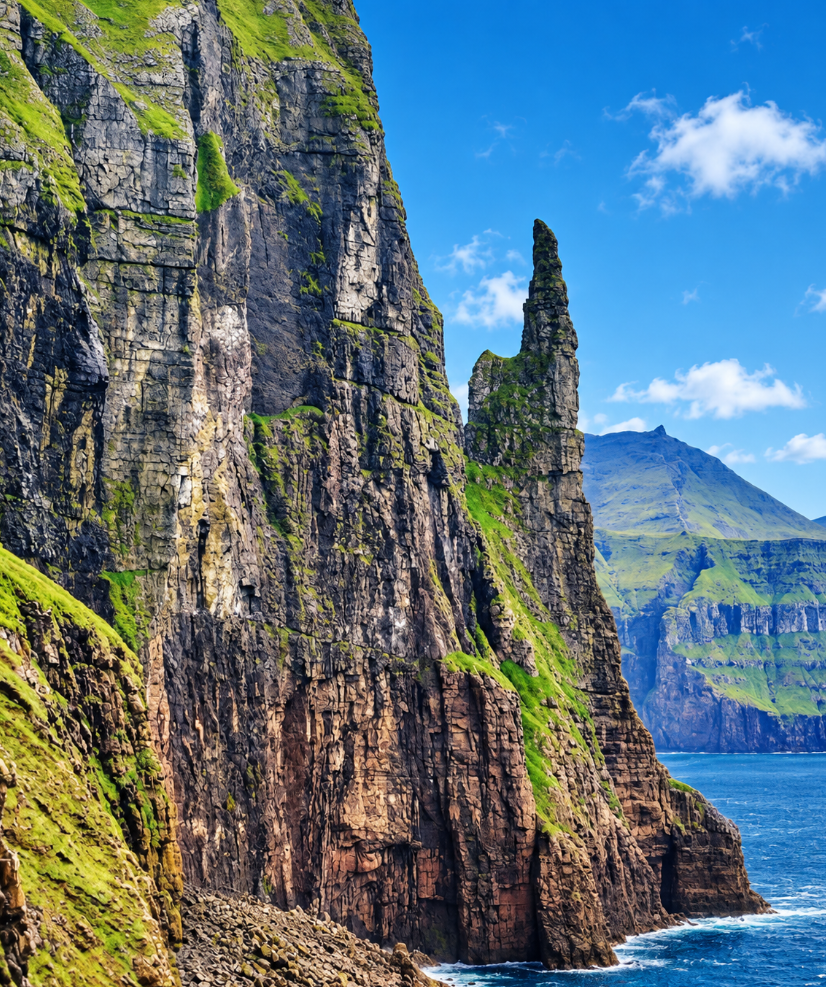
In 2012 did climbers return to the Witch’s Finger, successfully reaching the summit. In 2016, a team from New Zealand achieved the first ascent via the seaward face, a demanding five‑day climb that underscored the sheer difficulty of the rock.
To this day, only a handful of climbers—fewer than a dozen—are known to have stood atop Trøllkonufingur. The monolith remains one of the most elusive pinnacles in the North Atlantic.
Approaching the Witch’s Finger
For visitors, reaching the viewpoint is far less perilous than scaling the rock itself. From Sandavágur, a small carpark marks the trailhead. Vehicles are not permitted beyond this point, and signs direct walkers toward the path.
The initial section follows a sealed road before crossing a gated area. Beyond the gate, the trail becomes muddy, particularly after rain, so waterproof footwear is essential. The hike is short but rewarding. Covering about 3–3.9 kilometers round trip, it takes 20–30 minutes each way, with an elevation gain of roughly 100 meters.
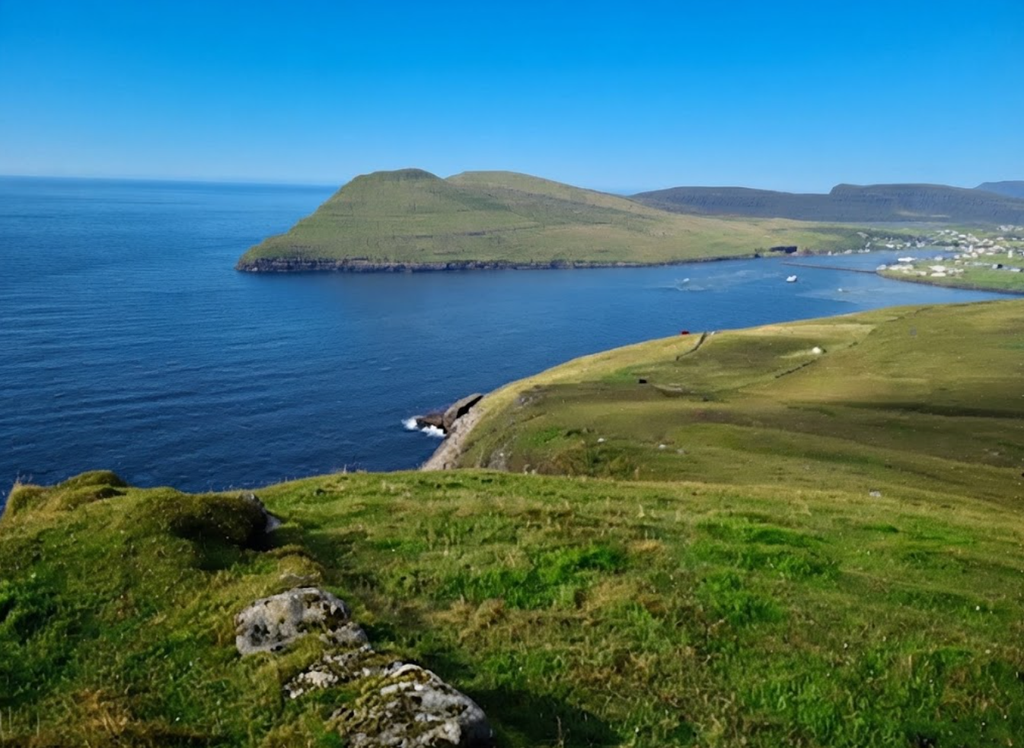
The path is classified as easy, though conditions can be slippery. The route is out‑and‑back, leading directly to a clifftop viewpoint. From here, the Witch’s Finger rises dramatically from the sea, framed by sweeping views of the Atlantic and the rugged coastline of Vágar.

The Journey from Tórshavn
Most travelers begin in Tórshavn, the Faroese capital. The drive to Sandavágur takes about 35 minutes, covering 36 kilometers one way. Roads are well surfaced, and a 2WD hire car is sufficient.
Rental agencies such as Avis, Budget, and Europcar operate from Vágar Airport and Tórshavn city center. Car hire is often one of the most significant expenses of a Faroese trip, so comparing prices in advance is recommended.
For those relying on public transport, Bus Line 300 connects Tórshavn to Sandavágur, running frequently along the airport route. Timetables are available through Strandfaraskip Landsins, the national transport service. While buses are reliable, they limit flexibility, making a car the preferred option for exploring Vágar’s scattered sights.

Weather and Safety
The Faroe Islands are notorious for unpredictable weather. Rain, mist, and strong winds can arrive suddenly, transforming a simple walk into a challenging experience. Visitors should carry a rainproof and windproof jacket, along with sturdy footwear.
Food and water should be packed before leaving Sandavágur, as there are no facilities along the trail. At the viewpoint, caution is essential. The cliffs are unfenced, and gusts of wind can be dangerous. Staying behind barriers and avoiding cliff edges is strongly advised. Despite its accessibility, the Witch’s Finger hike demands respect for the elements.
The Viewpoint Experience
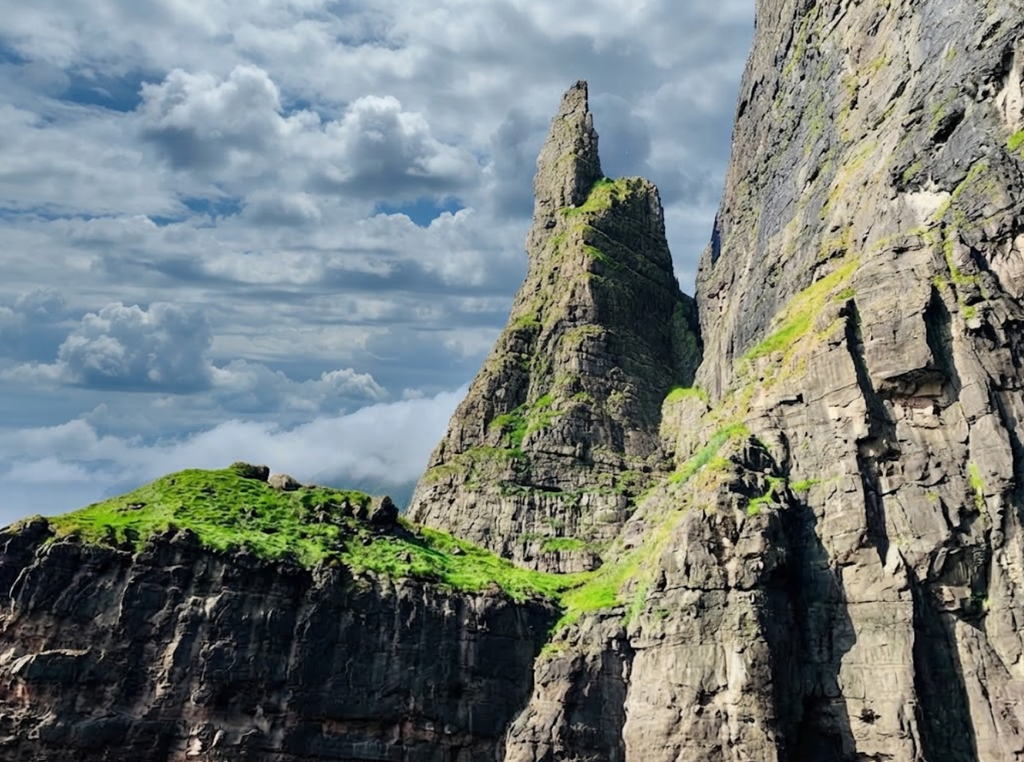
The reward for preparation is unforgettable. From the clifftop, Trøllkonufingur rises starkly from the ocean, its jagged form resembling a finger extended. The surrounding scenery includes grassy slopes, rocky outcrops, and glimpses of waterfalls. The Atlantic stretches endlessly beyond, its waves crashing against the base of the monolith.
The sight is both dramatic and lonely. Standing at the edge of the world, the Witch’s Finger radiates a sense of timelessness. It is a place where geology and mythology converge, where the natural and the supernatural blur into one.
Hiking Notes and Variations
The trail is straightforward, but variations exist. Some walkers begin at the fish house in Sandavágur, extending the route slightly. Others combine the Witch’s Finger viewpoint with nearby hikes, exploring Vágar’s diverse coastline. The path itself is well maintained, though some visitors note stretches of monotony before reaching the main feature. The climax, however, is worth every step.
For those seeking deeper engagement, guided tours are available. These typically last about two hours, offering historical context and folklore along the way. While a guide is not necessary for navigation, the stories enrich the experience, connecting the landscape to its cultural roots.
The Witch’s Finger in Faroese Identity
Beyond its physical presence, Trøllkonufingur embodies the spirit of the Faroe Islands. It is a symbol of resilience, rising defiantly against the Atlantic. It is a reminder of myth, where witches and trolls shaped the land. And it is a marker of human daring, where climbers risked everything to stand atop its summit.
For locals, the Witch’s Finger is part of a broader narrative of place. The Faroe Islands are defined by their dramatic landscapes, where cliffs, sea stacks, and fjords dominate. Each feature carries a story, and Trøllkonufingur’s tale of transformation and tragedy is among the most compelling.
Practical Travel Notes
Visitors should plan carefully. The hike itself is short, but weather can extend the time required. Allow 1–1.5 hours for the round trip, including time at the viewpoint. Pack essentials, dress for rain, and respect the cliffs.
Accommodation is available in Sandavágur and nearby villages, though many travelers base themselves in Tórshavn. From there, Vágar is easily accessible, with the Witch’s Finger forming part of a broader itinerary that might include Múlafossur Waterfall, Sørvágsvatn Lake, and the village of Bøur.
A Monument of Myth and Memory
Standing before Trøllkonufingur, one feels both awe and humility. The monolith is immense, yet solitary. It is shaped by nature, yet defined by legend. It is a place where past and present meet, where folklore lives alongside geology.
The Witch’s Finger is more than a hike. It is an encounter with the essence of the Faroe Islands: wild, untamed, mysterious, and unforgettable. Whether approached as a short walk from Sandavágur or contemplated from afar, it leaves an indelible impression.
Closing Reflection
The journey to Trøllkonufingur is not about distance or difficulty. It is about immersion in a landscape that defies expectation. It is about standing at the edge of cliffs, gazing at a solitary pinnacle, and hearing echoes of ancient tales. It is about recognizing the power of nature and the imagination of culture.
For those who seek the extraordinary, the Witch’s Finger delivers. It is a monument of stone and story, a landmark of the North Atlantic, and a reminder that the Faroe Islands are a place where myth still breathes in the wind.